- Published on
Pathology - Testicular Germ Cell Tumors
Risk factors comprise cryptorchidism, genetic factors, and testicular dysgenesis.
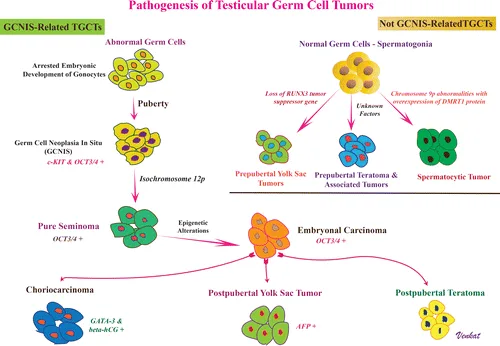
Seminoma(S) is the most prevalent type and is similar to ovarian dysgerminoma.
Embryonal carcinoma (EC) is the second most prevalent kind.
Endodermal sinus tumor (yolk sac tumor) (EST) is more prevalent in newborns and children.
Teratoma (T) accounts for 30% of all testicular tumors.
Choriocarcinoma (CC) is the most aggressive kind of cancer.
Seminoma consists of uniform cells with well-defined cell membranes, transparent cytoplasm, and a prominent nucleus.
Embryonal Carcinoma : Glandular or tubular cell patterns with papillary folds.
There is a mesodermal core with layers that resemble those found in primitive glomeruli (Endodermal sinus ( yolk tumor /EST)
Teratoma (T): Teratomas derived from many embryonic layers are usually malignant, unlike ovarian dermoid cysts.
Choriocarcinoma (CC): Sheets/cords of cells resembling syncytiotrophoblasts and cytotrophoblasts with transparent cytoplasm.
Symptom and Signs
Seminoma: Pain-free testicular swelling or lump that does not allow light to pass through upon inspection with a flashlight.
Embryonal Carcinoma : Painful testicular tumor frequently associated with metastases.
Endometrial Sinus Tumor :Testicular mass appears before the age of 3.
Teratoma :Symptoms include a painful bulge in the testes and gynecomastia.
Choriocarcinoma:Chief Complaint: Pain-free, nodular swelling in the testicles; development of breast tissue in males; presence of enlarged lymph nodes above the collarbone (if cancer has spread). Laboratory results show elevated levels of hCG in (S,EC,T,CC) samples, as well as elevated levels of AFP in (EST and T)
Therapy
Treatment options include radiotherapy, chemotherapy, and radical inguinal orchectomy. Testicular cancers predominantly affect Caucasian males aged 15 to 34.
Risk factors comprise cryptorchidism, genetic factors, and testicular dysgenesis.
Seminoma(S) is the most prevalent type and is similar to ovarian dysgerminoma.
Embryonal carcinoma (EC) is the second most prevalent kind.
Endodermal sinus tumor (yolk sac tumor) (EST) is more prevalent in newborns and children.
Teratoma (T) accounts for 30% of all testicular tumors.
Choriocarcinoma (CC) is the most aggressive kind of cancer.
Seminoma consists of uniform cells with well-defined cell membranes, transparent cytoplasm, and a prominent nucleus.
Embryonal Carcinoma : Glandular or tubular cell patterns with papillary folds.
There is a mesodermal core with layers that resemble those found in primitive glomeruli (Endodermal sinus ( yolk tumor /EST)
Teratoma (T): Teratomas derived from many embryonic layers are usually malignant, unlike ovarian dermoid cysts.
Choriocarcinoma (CC): Sheets/cords of cells resembling syncytiotrophoblasts and cytotrophoblasts with transparent cytoplasm.
Symptom and Signs
Seminoma: Pain-free testicular swelling or lump that does not allow light to pass through upon inspection with a flashlight.
Embryonal Carcinoma : Painful testicular tumor frequently associated with metastases.
Endometrial Sinus Tumor :Testicular mass appears before the age of 3.
Teratoma :Symptoms include a painful bulge in the testes and gynecomastia.
Choriocarcinoma:Chief Complaint: Pain-free, nodular swelling in the testicles; development of breast tissue in males; presence of enlarged lymph nodes above the collarbone (if cancer has spread). Laboratory results show elevated levels of hCG in (S,EC,T,CC) samples, as well as elevated levels of AFP in (EST and T)
Therapy
Treatment options include radiotherapy, chemotherapy, and radical inguinal orchectomy. Testicular cancers predominantly affect Caucasian males aged 15 to 34.
0 Comments
