- Published on
Pathology - Tuberous Sclerosis
Autosomal dominant condition caused by a mutation in one of several genes.
Pathology
A brain hamartoma, also known as a cortical tuber, is a solid nodule found in the cerebral cortex. It is made up of a disordered arrangement of neurons with large vesicular nuclei and eosinophilic cytoplasm.
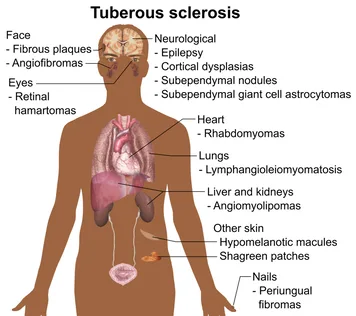
Additionally linked to tumors that develop outside the central nervous system, such as cardiac rhabdomyomas, adenoma sebaceum on the face (a lesion made up of deformed blood vessels), renal angiomyolipomas (a lesion composed of deformed blood vessels, adipocytes, and smooth muscle), and cysts in the bone and lung.
Symptoms and Signs
Infants may experience seizures and developmental delay. They may also develop red nodules on the face known as adenoma sebaceum between the ages of 5 and 10. Other symptoms may include issues associated to heart rhabdomyoma and renal angiomyolipoma.
Treatment involves managing symptoms such as controlling seizures and providing genetic counseling.
Autosomal dominant condition caused by a mutation in one of several genes.
Pathology
A brain hamartoma, also known as a cortical tuber, is a solid nodule found in the cerebral cortex. It is made up of a disordered arrangement of neurons with large vesicular nuclei and eosinophilic cytoplasm.
Additionally linked to tumors that develop outside the central nervous system, such as cardiac rhabdomyomas, adenoma sebaceum on the face (a lesion made up of deformed blood vessels), renal angiomyolipomas (a lesion composed of deformed blood vessels, adipocytes, and smooth muscle), and cysts in the bone and lung.
Symptoms and Signs
Infants may experience seizures and developmental delay. They may also develop red nodules on the face known as adenoma sebaceum between the ages of 5 and 10. Other symptoms may include issues associated to heart rhabdomyoma and renal angiomyolipoma.
Treatment involves managing symptoms such as controlling seizures and providing genetic counseling.
0 Comments
