- Published on
Pathology - Urinary Tract Infection
Pathophysiology
Recurrent infections have led to the development of chronic pyelonephritis. The agent is confirmed to be E. coli by a urine culture, as is typically the case in community-acquired UTIs.
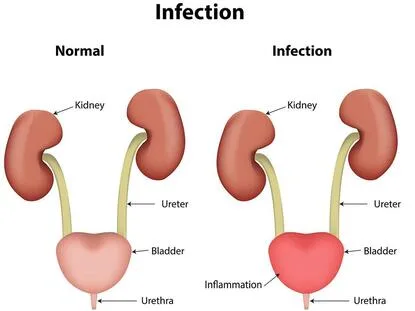
Getting a sexual history is crucial in order to rule out urethritis brought on by an STD. Urgency, frequency, and dysuria are signs of lower urinary tract involvement. Fever and flank pain are signs that the infection has progressed up the ureters and into the renal pelvis, where it has caused pyelonephritis. Although the issue is bilateral in this instance, it is typically unilateral. Tubular injury is indicated by the presence of hyperkalemia, ketoacidosis, and isosthenuria (low urine concentration or dilution). Renal scarring results from persistent or recurrent infections (small kidneys on ultrasonography), and interstitial fibroblasts, inflammatory cells, and substantial tubular loss are predicted findings in a biopsy.
Pathophysiology
Recurrent infections have led to the development of chronic pyelonephritis. The agent is confirmed to be E. coli by a urine culture, as is typically the case in community-acquired UTIs.
Getting a sexual history is crucial in order to rule out urethritis brought on by an STD. Urgency, frequency, and dysuria are signs of lower urinary tract involvement. Fever and flank pain are signs that the infection has progressed up the ureters and into the renal pelvis, where it has caused pyelonephritis. Although the issue is bilateral in this instance, it is typically unilateral. Tubular injury is indicated by the presence of hyperkalemia, ketoacidosis, and isosthenuria (low urine concentration or dilution). Renal scarring results from persistent or recurrent infections (small kidneys on ultrasonography), and interstitial fibroblasts, inflammatory cells, and substantial tubular loss are predicted findings in a biopsy.
0 Comments
