- Published on
Pathology - Wilms Tumor
Resulting from the loss of the WT-1 gene, a tumor suppressor, located on the short arm of chromosome 11.
Typically observed in young children aged 2 to 5.
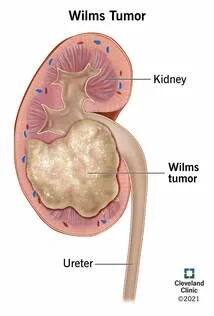
Pathology: A sizable, single, clearly defined mass in the kidney that arises from primitive metanephric tissue.
Microscopic examination reveals immature stroma with primitive tubules and glomeruli, along with mesenchymal features such as bone, cartilage, and connective tissue.
Clinical Symptoms
Typically appears as a large, painless lump in the side or abdomen of a young child; may also come with fever or stomach pain; can be linked to one-sided muscle enlargement (hemihypertrophy).
Laboratory results: Microscopic presence of blood in urine.
Tumor removal surgery followed by radiation and chemotherapy with actinomycin D and vincristine.
The survival rate is great.
Wilms tumor may be linked with the WAGR complex, which includes Wilms tumor, aniridia (lack of iris), genitourinary malformation, and mental-motor retardation.
Resulting from the loss of the WT-1 gene, a tumor suppressor, located on the short arm of chromosome 11.
Typically observed in young children aged 2 to 5.
Pathology: A sizable, single, clearly defined mass in the kidney that arises from primitive metanephric tissue.
Microscopic examination reveals immature stroma with primitive tubules and glomeruli, along with mesenchymal features such as bone, cartilage, and connective tissue.
Clinical Symptoms
Typically appears as a large, painless lump in the side or abdomen of a young child; may also come with fever or stomach pain; can be linked to one-sided muscle enlargement (hemihypertrophy).
Laboratory results: Microscopic presence of blood in urine.
Tumor removal surgery followed by radiation and chemotherapy with actinomycin D and vincristine.
The survival rate is great.
Wilms tumor may be linked with the WAGR complex, which includes Wilms tumor, aniridia (lack of iris), genitourinary malformation, and mental-motor retardation.
0 Comments
