- Published on
Pathology - Zollinger-Ellison Syndrome
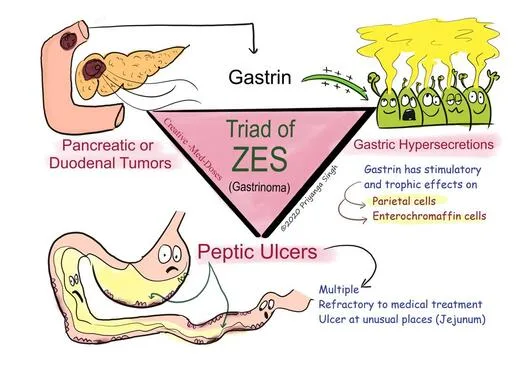
Gastrinoma is typically caused by a pancreatic islet cell tumor. While most gastrinomas occur sporadically, 25% are linked to Multiple Endocrine Neoplasia Type I (MEN I).
Gastrinoma can originate in the pancreas, duodenum, or adjacent tissues. They are frequently malignant and tend to spread to the liver, although they typically do not exhibit anaplasia histologically.
Gastrinomas release gastrin, which results in acid hypersecretion, leading to peptic ulcers and inactivation of pancreatic enzymes.
Peptic ulcer disease in the duodenum can lead to ulcer perforation, along with symptoms such as diarrhea, steatorrhea, and weight loss due to pancreatic enzyme inactivation.
Laboratory results: Elevated gastrin levels, reduced stomach acidity.
Excision of gastrinoma; regulation of stomach acid production with proton pump inhibitors.
Insulinoma is a pancreatic tumor that results in excessive release of insulin and elevated levels of C-peptide, a chemical produced during insulin manufacture. It is linked to the Whipple triad, which consists of episodic hyperinsulinemia and hypoglycemia, hypoglycemic CNS impairment, and the reversal of CNS dysfunction when hypoglycemia is resolved.
Gastrinoma is typically caused by a pancreatic islet cell tumor. While most gastrinomas occur sporadically, 25% are linked to Multiple Endocrine Neoplasia Type I (MEN I).
Gastrinoma can originate in the pancreas, duodenum, or adjacent tissues. They are frequently malignant and tend to spread to the liver, although they typically do not exhibit anaplasia histologically.
Gastrinomas release gastrin, which results in acid hypersecretion, leading to peptic ulcers and inactivation of pancreatic enzymes.
Peptic ulcer disease in the duodenum can lead to ulcer perforation, along with symptoms such as diarrhea, steatorrhea, and weight loss due to pancreatic enzyme inactivation.
Laboratory results: Elevated gastrin levels, reduced stomach acidity.
Excision of gastrinoma; regulation of stomach acid production with proton pump inhibitors.
Insulinoma is a pancreatic tumor that results in excessive release of insulin and elevated levels of C-peptide, a chemical produced during insulin manufacture. It is linked to the Whipple triad, which consists of episodic hyperinsulinemia and hypoglycemia, hypoglycemic CNS impairment, and the reversal of CNS dysfunction when hypoglycemia is resolved.
0 Comments
