- Published on
Surgery - Achalasia
Introduction
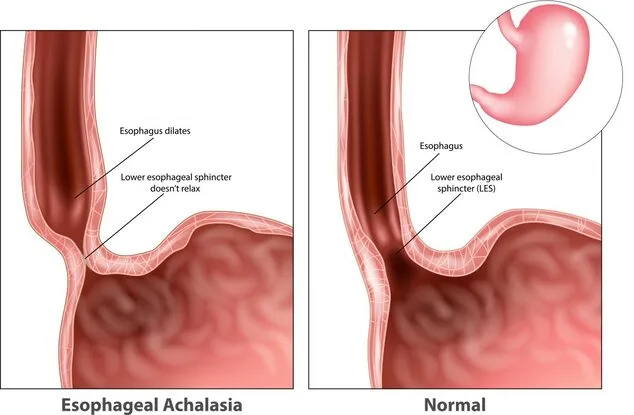
an oesophageal motor condition characterized by loss of peristalsis during swallowing and failure of the lower oesophageal sphincter (LES) to relax.
Etiology
Impaired relaxation of the lower sphincter and disruption of peristaltic coordination are the results of degeneration of the intramural ganglions of the myenteric (Auerbach's) plexus. The deterioration may have an infectious or autoimmune cause, however this is uncertain. Similar symptoms can be brought on by the parasite protozoon Trypanosome cruzi, however this condition is exclusive to South America.
Epidemiology
0.5 out of 100,000 cases annually. mostly during the middle ages. Not a difference in race or gender.
History
Dysphagia involving solids and liquids, first intermittent. Weight loss, coughing/recurrent chest infections, atypical/cramping retrosternal chest discomfort or fullness, and regurgitating undigested food or retained saliva are prevalent.
Investigations
Barium swallow: The oesophagus's body lacks peristalsis, which smoothly tapers down to the lower oesophageal sphincter, giving the appearance of a bird's beak. Long-term condition characterized by tortuous dilated oesophagus with retained food, where CXR may reveal dilated oesophagus, double right heart border, and fluid behind heart shadow.Oesophagoscopy/endoscopic ultrasound: To rule out stricture or malignancy, as tumors may be the cause of pseudoachalasia. Although not required for diagnosis, a biopsy may reveal absence of nerve fibers or hypertrophy in the muscles.
Gastrointestinal manometry: The classic findings include aperistalsis of the oesophagus body, higher lower oesophageal sphincter pressure, and failure of the lower oesophageal sphincter to relax upon swallowing. "Vigorous" achalasia: a condition in which swallowing causes the oesophagus's body to flex violently and painfully.
Blood: It is rarely necessary to rule out Chagas' illness (testing positive for T. cruzi).
Management
Reducing the lower oesophageal sphincter pressure is the goal of all available treatments:
Medical: Pre-meals isosorbide mononitrate (short-term relief) or calcium channel antagonists such as nifedipine or verapamil.
Endoscopic: LES dilatation with a pneumatic balloon (80% success rate, slight perforation risk). More than 75% of patients find that injections of botulinum toxin into the lower epidermis (LES) are beneficial; nevertheless, symptoms usually return within six months, many treatments are needed, and responsiveness may deteriorate. Usually reserved for patients who are not a good fit for surgery or balloon dilatation.
Surgery: Heller's cardiomyotomy: anterior myotomy of LES is currently primarily carried out laparoscopically (although some centers use a robotic technique). To stop gastro-oesophageal reflux, fundoplication—typically anterior Dor—can be used in conjunction with Heller's cardiomyotomy. Results: decent to very good symptom relief.
Complications
Aspiration pneumonia, starvation, and weight loss could occur if left untreated. Over time, there is a higher chance of oesophageal cancer, particularly squamous cell carcinoma, hence endoscopic monitoring and biopsy are advised.
Of Heller's: Perforation (7–15%), elevated risk in patients with prior Botox injections because of reflux, submucosal fibrosis, and recurrence (early: scarring or technical failure, late: advancement of the disease).
Prognosis
There is no cure, however single or combination treatments can effectively manage up to 90% of patients.
Introduction
an oesophageal motor condition characterized by loss of peristalsis during swallowing and failure of the lower oesophageal sphincter (LES) to relax.
Etiology
Impaired relaxation of the lower sphincter and disruption of peristaltic coordination are the results of degeneration of the intramural ganglions of the myenteric (Auerbach's) plexus. The deterioration may have an infectious or autoimmune cause, however this is uncertain. Similar symptoms can be brought on by the parasite protozoon Trypanosome cruzi, however this condition is exclusive to South America.
Epidemiology
0.5 out of 100,000 cases annually. mostly during the middle ages. Not a difference in race or gender.
History
Dysphagia involving solids and liquids, first intermittent. Weight loss, coughing/recurrent chest infections, atypical/cramping retrosternal chest discomfort or fullness, and regurgitating undigested food or retained saliva are prevalent.
Investigations
Barium swallow: The oesophagus's body lacks peristalsis, which smoothly tapers down to the lower oesophageal sphincter, giving the appearance of a bird's beak. Long-term condition characterized by tortuous dilated oesophagus with retained food, where CXR may reveal dilated oesophagus, double right heart border, and fluid behind heart shadow.Oesophagoscopy/endoscopic ultrasound: To rule out stricture or malignancy, as tumors may be the cause of pseudoachalasia. Although not required for diagnosis, a biopsy may reveal absence of nerve fibers or hypertrophy in the muscles.
Gastrointestinal manometry: The classic findings include aperistalsis of the oesophagus body, higher lower oesophageal sphincter pressure, and failure of the lower oesophageal sphincter to relax upon swallowing. "Vigorous" achalasia: a condition in which swallowing causes the oesophagus's body to flex violently and painfully.
Blood: It is rarely necessary to rule out Chagas' illness (testing positive for T. cruzi).
Management
Reducing the lower oesophageal sphincter pressure is the goal of all available treatments:
Medical: Pre-meals isosorbide mononitrate (short-term relief) or calcium channel antagonists such as nifedipine or verapamil.
Endoscopic: LES dilatation with a pneumatic balloon (80% success rate, slight perforation risk). More than 75% of patients find that injections of botulinum toxin into the lower epidermis (LES) are beneficial; nevertheless, symptoms usually return within six months, many treatments are needed, and responsiveness may deteriorate. Usually reserved for patients who are not a good fit for surgery or balloon dilatation.
Surgery: Heller's cardiomyotomy: anterior myotomy of LES is currently primarily carried out laparoscopically (although some centers use a robotic technique). To stop gastro-oesophageal reflux, fundoplication—typically anterior Dor—can be used in conjunction with Heller's cardiomyotomy. Results: decent to very good symptom relief.
Complications
Aspiration pneumonia, starvation, and weight loss could occur if left untreated. Over time, there is a higher chance of oesophageal cancer, particularly squamous cell carcinoma, hence endoscopic monitoring and biopsy are advised.
Of Heller's: Perforation (7–15%), elevated risk in patients with prior Botox injections because of reflux, submucosal fibrosis, and recurrence (early: scarring or technical failure, late: advancement of the disease).
Prognosis
There is no cure, however single or combination treatments can effectively manage up to 90% of patients.
0 Comments
