- Published on
Surgery - Cholecystectomy
Indications
Symptomatic gallstones.
can be performed in an acute situation, that is, on a gallbladder that is "hot," within 72 hours of the commencement of acute cholecystitis.
For cholecystectomy that is open: suspected malignancy of the gallbladder.
Switching from laparoscopic to Incapacity to recognize anatomy, such as several adhesions, stagnation, or postoperative problems.
Anatomy
The fundus, body, infundibulum, and neck—which has the potential to produce a Hartmann's pouch—compose the gallbladder. The mucosa of the cystic duct, which joins the gallbladder to the confluence of the common bile and hepatic ducts, produces spiral valves of Heister folds. Variations in anatomy are frequent. Calot's triangle, which is composed of the liver's inferior border, the common hepatic duct medially, and the cystic duct inferiorly, is crucial to dissection. Usually passing through here and leading to the gallbladder is the cystic artery, a branch of the right hepatic artery.
It is possible for a Luschka duct to go straight between the gallbladder and the liver.
Investigations
Preoperative ultrasound for gallstone diagnosis. The baseline blood tests are FBC, U&Es, LFTs, and G&S.
Post-operative: A day case procedure for laparoscopic cholecystectomy is possible. DVT prevention.
Procedure
Anesthesia: anesthesia generale. prophylactic antibiotic use in case of bile leakage.
Operation:
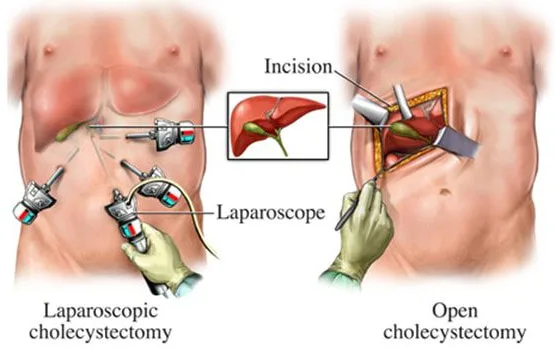
Laparoscopy: Either a closed (Veress needle) or an open (Hassan) approach is used to introduce the primary trocar. Insufflation of CO2 produces a pneumoperitoneum. Following examination, three more ports are inserted under direct vision: two along the right costal margin and one epigastric port. The stomach can be made smaller with the use of a nasogastric tube.
The head of the patient is cocked to the right.
Open: A Kocher's (right subcostal) incision is made.
Cholecystectomy: Calot's triangle is shown by grasping and retracting the gallbladder upward. Vigilance is required for anatomical variation. Omental and peritoneal adhesions are split, and dissection is undertaken to find the cystic duct and cystic artery.
If necessary, an intraoperative cholangiogram can be carried out to detect stones in the common bile duct after the cystic duct is severed close to the gallbladder. The cystic artery and duct are split and clipped both distally and proximally. Next, the gallbladder is removed from the liver's subsurface. Gallstones that have spilled should be found and removed. If bleeding or bile leakage is a concern, a subhepatic drain may be implanted.
Closure: A bag containing the gallbladder is used. After local lavage if required and hemostasis, the bag is removed using a port site. The incisions are closed and the ports are taken out under direct vision.
Complications
Early: bleeding, visceral injury, infection, bile leak, bile duct injury (risk enhanced in the presence of active inflammation).
Extensive dyspeptic symptoms following cholecystectomy, biliary stricture, portsite or incisional hernias are examples of late complications.
Indications
Symptomatic gallstones.
can be performed in an acute situation, that is, on a gallbladder that is "hot," within 72 hours of the commencement of acute cholecystitis.
For cholecystectomy that is open: suspected malignancy of the gallbladder.
Switching from laparoscopic to Incapacity to recognize anatomy, such as several adhesions, stagnation, or postoperative problems.
Anatomy
The fundus, body, infundibulum, and neck—which has the potential to produce a Hartmann's pouch—compose the gallbladder. The mucosa of the cystic duct, which joins the gallbladder to the confluence of the common bile and hepatic ducts, produces spiral valves of Heister folds. Variations in anatomy are frequent. Calot's triangle, which is composed of the liver's inferior border, the common hepatic duct medially, and the cystic duct inferiorly, is crucial to dissection. Usually passing through here and leading to the gallbladder is the cystic artery, a branch of the right hepatic artery.
It is possible for a Luschka duct to go straight between the gallbladder and the liver.
Investigations
Preoperative ultrasound for gallstone diagnosis. The baseline blood tests are FBC, U&Es, LFTs, and G&S.
Post-operative: A day case procedure for laparoscopic cholecystectomy is possible. DVT prevention.
Procedure
Anesthesia: anesthesia generale. prophylactic antibiotic use in case of bile leakage.
Operation:
Laparoscopy: Either a closed (Veress needle) or an open (Hassan) approach is used to introduce the primary trocar. Insufflation of CO2 produces a pneumoperitoneum. Following examination, three more ports are inserted under direct vision: two along the right costal margin and one epigastric port. The stomach can be made smaller with the use of a nasogastric tube.
The head of the patient is cocked to the right.
Open: A Kocher's (right subcostal) incision is made.
Cholecystectomy: Calot's triangle is shown by grasping and retracting the gallbladder upward. Vigilance is required for anatomical variation. Omental and peritoneal adhesions are split, and dissection is undertaken to find the cystic duct and cystic artery.
If necessary, an intraoperative cholangiogram can be carried out to detect stones in the common bile duct after the cystic duct is severed close to the gallbladder. The cystic artery and duct are split and clipped both distally and proximally. Next, the gallbladder is removed from the liver's subsurface. Gallstones that have spilled should be found and removed. If bleeding or bile leakage is a concern, a subhepatic drain may be implanted.
Closure: A bag containing the gallbladder is used. After local lavage if required and hemostasis, the bag is removed using a port site. The incisions are closed and the ports are taken out under direct vision.
Complications
Early: bleeding, visceral injury, infection, bile leak, bile duct injury (risk enhanced in the presence of active inflammation).
Extensive dyspeptic symptoms following cholecystectomy, biliary stricture, portsite or incisional hernias are examples of late complications.
0 Comments
