- Published on
Surgery - Gastric Cancer
Introduction
Adenocarcinoma is the most prevalent type of gastric cancer; lymphoma and leiomyosarcoma are less common.
Etiology
linked to atrophic gastritis and Helicobacter pylori infection.
Hereditary diffuse stomach cancer is caused by germline mutations in E-cadherin.
a diet heavy in processed and smoked foods, alcohol, smoking, and nitrosamines.
Blood type A (relative risk: 1.2).
Anemia pernicious.
prior partial stomach removal.
H. pylori infection has a very strong causative association with MALT lymphomas.
Epidemiology
Cancer is a common cause of mortality worldwide, with Eastern Europe, China, and Japan having the highest incidence. Incidence of the sixth most prevalent cancer in the UK is 15 per 100,000. Male to female ratio is 2:1.
Age of presentation is often over 50. Cancers of the body and antrum are declining, but those of the heart and gastro-oesophageal junction are rising.
History
Early asymptomatic; later, weight loss, anorexia, nausea, epigastric pain, indigestion, anemia, and gastrointestinal hemorrhage. Metastatic illness symptoms include jaundice (liver involvement) and distention of the abdomen (ascites).
Examination
Ascites and an epigastric mass are late indicators.
Signs of eponymy discovered in metastatic spread:
Virchow's node, also known as Troisier's sign, refers to palpable lymph nodes located in the left supraclavicular fossa.
The umbilicus has a metastatic nodule on Sister Mary Joseph's node.
& Krukenberg tumor: Spreads to the ovaries.
Investigations
Upper gastrointestinal endoscopy: Multi-quadrant biopsy for every stomach ulcer.
Determine the local lymph node involvement and the depth of stomach invasion (T stage) using endoscopic ultrasonography.
CT scan: Tumor staging.
Laparoscopy staging: Allows for the detection of local or transperitoneal spread.
Pathology:
Macroscopic: According to Borrmann's classification, polypoid, ulcerating, or infiltrative tumors; if widespread, they may result in linitis plastica, also known as leather-bottle stomach.
Internal and diffuse kinds are microscopic.
Management
Surgery: Subtotal or total gastrectomy (see Gastrectomies) is the cornerstone for early disease.
Dissection of lymph nodes classified as D1 (containing perigastric N1 nodes) and D2 (with N2 layer of nodes; proponents of the latter name are Japanese). elevated mortality and morbidity rates following D2 and overall gastrectomy. For staging, at least 15 nodes are needed.
Palliative care may involve procedures like gastrojejunostomy or stenting to keep enteral feeding going.
Medical: The MAGIC study, ECF chemotherapy, showed that neoadjuvant chemotherapy improved 5-year survival (36% against 23% for surgery alone).
Palliation is the goal of therapy for advanced illness. increased rates of response with combined treatment.
Complications
dysphagia, gastric outlet obstruction, iron deficiency anemia, and upper gastrointestinal bleeding. Gastrectomy side effects, both early and late (dumping syndrome, diarrhea, vitamin B12 deficiency, etc.).
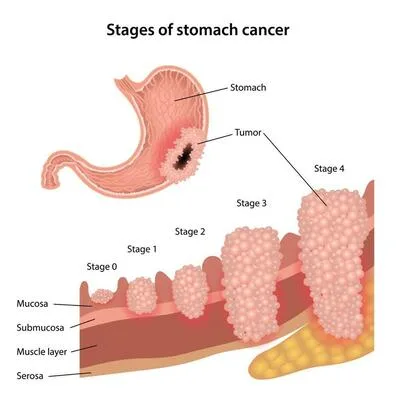
Gastric cancers have the potential to spread haematogenously to the liver and lungs, transperitoneally, via lymph nodes, or directly through the stomach wall.
Prognosis
bad generally, with a 5-year survival rate of 20% (60% in Japan), greater in patients with early illness who are undergoing resection.
Staging: based on clinical and pathological data, either the Birmingham Staging method or the TNM method.
Introduction
Adenocarcinoma is the most prevalent type of gastric cancer; lymphoma and leiomyosarcoma are less common.
Etiology
linked to atrophic gastritis and Helicobacter pylori infection.
Hereditary diffuse stomach cancer is caused by germline mutations in E-cadherin.
a diet heavy in processed and smoked foods, alcohol, smoking, and nitrosamines.
Blood type A (relative risk: 1.2).
Anemia pernicious.
prior partial stomach removal.
H. pylori infection has a very strong causative association with MALT lymphomas.
Epidemiology
Cancer is a common cause of mortality worldwide, with Eastern Europe, China, and Japan having the highest incidence. Incidence of the sixth most prevalent cancer in the UK is 15 per 100,000. Male to female ratio is 2:1.
Age of presentation is often over 50. Cancers of the body and antrum are declining, but those of the heart and gastro-oesophageal junction are rising.
History
Early asymptomatic; later, weight loss, anorexia, nausea, epigastric pain, indigestion, anemia, and gastrointestinal hemorrhage. Metastatic illness symptoms include jaundice (liver involvement) and distention of the abdomen (ascites).
Examination
Ascites and an epigastric mass are late indicators.
Signs of eponymy discovered in metastatic spread:
Virchow's node, also known as Troisier's sign, refers to palpable lymph nodes located in the left supraclavicular fossa.
The umbilicus has a metastatic nodule on Sister Mary Joseph's node.
& Krukenberg tumor: Spreads to the ovaries.
Investigations
Upper gastrointestinal endoscopy: Multi-quadrant biopsy for every stomach ulcer.
Determine the local lymph node involvement and the depth of stomach invasion (T stage) using endoscopic ultrasonography.
CT scan: Tumor staging.
Laparoscopy staging: Allows for the detection of local or transperitoneal spread.
Pathology:
Macroscopic: According to Borrmann's classification, polypoid, ulcerating, or infiltrative tumors; if widespread, they may result in linitis plastica, also known as leather-bottle stomach.
Internal and diffuse kinds are microscopic.
Management
Surgery: Subtotal or total gastrectomy (see Gastrectomies) is the cornerstone for early disease.
Dissection of lymph nodes classified as D1 (containing perigastric N1 nodes) and D2 (with N2 layer of nodes; proponents of the latter name are Japanese). elevated mortality and morbidity rates following D2 and overall gastrectomy. For staging, at least 15 nodes are needed.
Palliative care may involve procedures like gastrojejunostomy or stenting to keep enteral feeding going.
Medical: The MAGIC study, ECF chemotherapy, showed that neoadjuvant chemotherapy improved 5-year survival (36% against 23% for surgery alone).
Palliation is the goal of therapy for advanced illness. increased rates of response with combined treatment.
Complications
dysphagia, gastric outlet obstruction, iron deficiency anemia, and upper gastrointestinal bleeding. Gastrectomy side effects, both early and late (dumping syndrome, diarrhea, vitamin B12 deficiency, etc.).
Gastric cancers have the potential to spread haematogenously to the liver and lungs, transperitoneally, via lymph nodes, or directly through the stomach wall.
Prognosis
bad generally, with a 5-year survival rate of 20% (60% in Japan), greater in patients with early illness who are undergoing resection.
Staging: based on clinical and pathological data, either the Birmingham Staging method or the TNM method.
0 Comments
