- Published on
Surgery - Hemorrhoids
Introduction
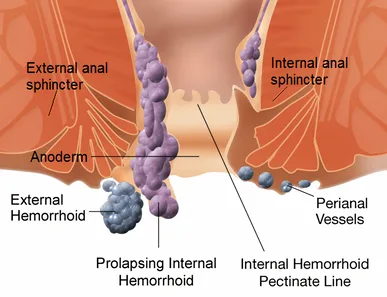
Engorged and swollen anal vascular cushions have a propensity to protrude, hemorrhage, or prolapse into the anal canal, which aids in anal closure.
arranged according to location:
.. Internal (originating above the dentate line from the superior hemorrhoidal plexus). External (below dentate line, from inferior hemorrhoidal plexus)
categorized according to prolapse degree:
.. Initial degree: Non-prolapse hemorrhoids. Second degree: Prolapse that occurs with defecation but goes away on its own. Third degree: Prolapse that needs to be manually reduced. Fourth degree: Non-reducible prolapse.
Risk Factors
pregnancy, extended straining, constipation, and portal hypertension.
Epidemiology
Common (4–5% prevalence). The peak age range is 45–65. mostly a Westernized world sickness.
H HISTORY
usually without symptoms.
Bleeding, typically bright red blood, on toilet paper or dripping into a pan following the passage of stool is possible, but it is never mixed in with the stool itself. The absence of warning signs such as weight loss, anemia, altered bowel habits, clotted, black blood, or mucus mixed with feces is necessary. Itching, anal tumors, or prolapsing tissue are other symptoms. When external hemorrhoids thrombose, they can be extremely painful.
Examination
Uncomplicated hemorrhoids are impalpable and only visible on proctoscopy, where they manifest as red, granular mucosal swellings that bulge into view upon straining and withdrawing the proctoscope at 3, 7, and 11 o'clock. First- or second-degree hemorrhoids are typically not visible on external inspection. Anal tags, anal fissure, rectal prolapse, polyps, or tumors are examples of differential diagnosis.
Pathogenesis
Overstretching results in anal engorgement, shearing by hard stools, and downward displacement, which in turn causes hypertrophy and fragmentation of muscle and elastin fibers, disruption of tissue organization, elevated resting anal pressures, and bleeding from pre-sinusoidal arterioles.
Investigations
To rule out a rectal source of bleeding, either a rigid or flexible sigmoidoscopy is typically necessary because hemorrhoids are frequently associated with colorectal tumors.
Management
Conservative: Suggestions for a diet rich in fiber, water consumption, and large laxatives. There are topical lotions that mix a local anesthetic with mild astringents; those that contain corticosteroids should only be applied temporarily.
For first or second degree local therapy: Injection sclerotherapy involves injecting 5% phenol in almond oil into the submucosa above a hemorrhoid, above the dentate line (where sensory fibers are absent), causing inflammation and fibrosis that leads to mucosal fixation. Banding: Barron's bands are placed immediately proximal to the hemorrhage, including tissue that disappears in two to three days, leaving a tiny ulcer to heal naturally. higher chances of recovery but sometimes more agony. Hemorrhoidal artery ligation, radiofrequency ablation, and infrared coagulation are further methods.
Surgical: Saved for third- or fourth-degree hemorrhoids that present with symptoms. In order to prevent stricturing, the Milligan-Morgan open hemorrhoidectomy entails removing the hemorrhoidal cushions while maintaining the skin and mucosal bridges that connect the hemorrhoids. In order to "hitch up" the prolapsing anal lining and interrupt the proximal blood flow, stapled hemorrhoidectomy involves mucosectomy 2 cm proximal to the dentate line (# discomfort and shorter convalescence in randomized control trials). laxatives to prevent constipation after surgery, metronidazole.
Complications
thrombosis, prolapse, and bleeding. Prostatitis, perineal sepsis, hepatic abscesses, retroperitoneal sepsis, and infrequently impotence are side effects of injectable sclerotherapy. Pain, bleeding, recurrence, and, less frequently, incontinence from sphincteric damage and anal stricture following a hemorrhoidectomy.
Prognosis
Frequently a chronic issue requiring repeated local treatments due to symptom recurrence.
Severe symptoms may be permanently relieved by surgery.
Introduction
Engorged and swollen anal vascular cushions have a propensity to protrude, hemorrhage, or prolapse into the anal canal, which aids in anal closure.
arranged according to location:
.. Internal (originating above the dentate line from the superior hemorrhoidal plexus). External (below dentate line, from inferior hemorrhoidal plexus)
categorized according to prolapse degree:
.. Initial degree: Non-prolapse hemorrhoids. Second degree: Prolapse that occurs with defecation but goes away on its own. Third degree: Prolapse that needs to be manually reduced. Fourth degree: Non-reducible prolapse.
Risk Factors
pregnancy, extended straining, constipation, and portal hypertension.
Epidemiology
Common (4–5% prevalence). The peak age range is 45–65. mostly a Westernized world sickness.
H HISTORY
usually without symptoms.
Bleeding, typically bright red blood, on toilet paper or dripping into a pan following the passage of stool is possible, but it is never mixed in with the stool itself. The absence of warning signs such as weight loss, anemia, altered bowel habits, clotted, black blood, or mucus mixed with feces is necessary. Itching, anal tumors, or prolapsing tissue are other symptoms. When external hemorrhoids thrombose, they can be extremely painful.
Examination
Uncomplicated hemorrhoids are impalpable and only visible on proctoscopy, where they manifest as red, granular mucosal swellings that bulge into view upon straining and withdrawing the proctoscope at 3, 7, and 11 o'clock. First- or second-degree hemorrhoids are typically not visible on external inspection. Anal tags, anal fissure, rectal prolapse, polyps, or tumors are examples of differential diagnosis.
Pathogenesis
Overstretching results in anal engorgement, shearing by hard stools, and downward displacement, which in turn causes hypertrophy and fragmentation of muscle and elastin fibers, disruption of tissue organization, elevated resting anal pressures, and bleeding from pre-sinusoidal arterioles.
Investigations
To rule out a rectal source of bleeding, either a rigid or flexible sigmoidoscopy is typically necessary because hemorrhoids are frequently associated with colorectal tumors.
Management
Conservative: Suggestions for a diet rich in fiber, water consumption, and large laxatives. There are topical lotions that mix a local anesthetic with mild astringents; those that contain corticosteroids should only be applied temporarily.
For first or second degree local therapy: Injection sclerotherapy involves injecting 5% phenol in almond oil into the submucosa above a hemorrhoid, above the dentate line (where sensory fibers are absent), causing inflammation and fibrosis that leads to mucosal fixation. Banding: Barron's bands are placed immediately proximal to the hemorrhage, including tissue that disappears in two to three days, leaving a tiny ulcer to heal naturally. higher chances of recovery but sometimes more agony. Hemorrhoidal artery ligation, radiofrequency ablation, and infrared coagulation are further methods.
Surgical: Saved for third- or fourth-degree hemorrhoids that present with symptoms. In order to prevent stricturing, the Milligan-Morgan open hemorrhoidectomy entails removing the hemorrhoidal cushions while maintaining the skin and mucosal bridges that connect the hemorrhoids. In order to "hitch up" the prolapsing anal lining and interrupt the proximal blood flow, stapled hemorrhoidectomy involves mucosectomy 2 cm proximal to the dentate line (# discomfort and shorter convalescence in randomized control trials). laxatives to prevent constipation after surgery, metronidazole.
Complications
thrombosis, prolapse, and bleeding. Prostatitis, perineal sepsis, hepatic abscesses, retroperitoneal sepsis, and infrequently impotence are side effects of injectable sclerotherapy. Pain, bleeding, recurrence, and, less frequently, incontinence from sphincteric damage and anal stricture following a hemorrhoidectomy.
Prognosis
Frequently a chronic issue requiring repeated local treatments due to symptom recurrence.
Severe symptoms may be permanently relieved by surgery.
0 Comments
