- Published on
Surgery - Hiatal Hernia
Introduction
stomach herniation that occurs when the stomach pushes past the diaphragm's oesophageal hiatus and into the mediastinum.
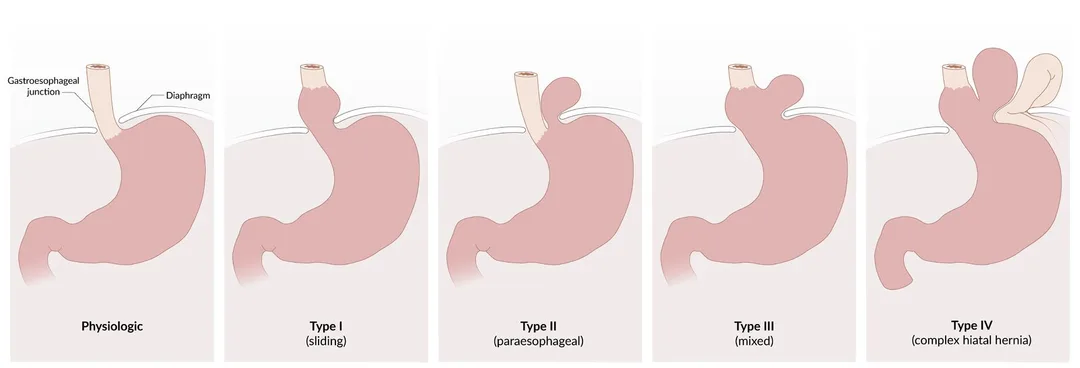
Type I (sliding): The diaphragm lies below the gastro-oesophageal junction (GOJ).
Type II (rolling/para-oesophageal): The lead point of the herniation is the gastric fundus, however there is a defect in the phreno-oesophageal membrane and the GOJ does not migrate.
Type III: A blend of I and II types.
Type IV: Large defect with pancreatic and colon herniation, among other organs.
Etiology
Congenital or acquired, such as the phreno-oesophageal ligament's weakening and increased flexibility with aging. linked to chronic oesophagitis, obesity, and gastro-oesophageal reflux disease (GORD).
Epidemiology
The most prevalent type, Type I, becomes more frequent as one ages. Five percent roll, and ninety-five percent slide.
History
lots of asymptomatic. Heartburn, indigestion, postprandial fullness, and regurgitation are signs of reflux.
Examination
Until difficulties arise, a hiatus hernia usually shows no symptoms.
Investigations
Endoscopy: Hernia diagnosis and/or associated problems (e.g., Barrett's oesophagus, ulceration, oesophagitis).
Radiology: barium swallow, meal, or CXR (large hernias can show up as a gastric air bubble behind the heart).
Via high-resolution manometry, sliding hernias can be identified.
Management
Changes to lifestyle factors: Losing weight, skipping late meals, etc.
Medical: proton pump inhibitors, H2 antagonists, and antacids.
Surgery: Only required in a small percentage of cases. The conditions that qualify for this treatment include para-oesophageal hernia, which increases the risk of strangulation and imprisonment, mass reflux, and pulmonary problems. Currently frequently fixed by laparoscopy. Hernia reduction, crural repair, either with or without prosthetic reinforcement, and antireflux fundoplication—such as Nissen's—are all part of the surgical procedure.
Because there is a chance of infection, stricture, and mesh erosion, mesh repairs are debatable.
Complications
Problems with the oesophagus: Barrett's oesophagus, erosions or ulcerations, strictures, and esophagitis.
Additional: In rare cases, para-oesophageal hernia imprisonment, strangulation, or perforation. With time, a paraoesophageal hernia may get larger and can cause breathing difficulties and an upside-down stomach when the entire stomach is inside the thoracic cavity.
After surgery: Large hiatus hernias have high recurrence rates (5–30%). Among mesh repairs are visceral erosion, stricturing, and infection.
Prognosis
Generally decent, with the most not posing serious issues. Compared to rolling hernias, sliding hernias have a better prognosis.
Introduction
stomach herniation that occurs when the stomach pushes past the diaphragm's oesophageal hiatus and into the mediastinum.
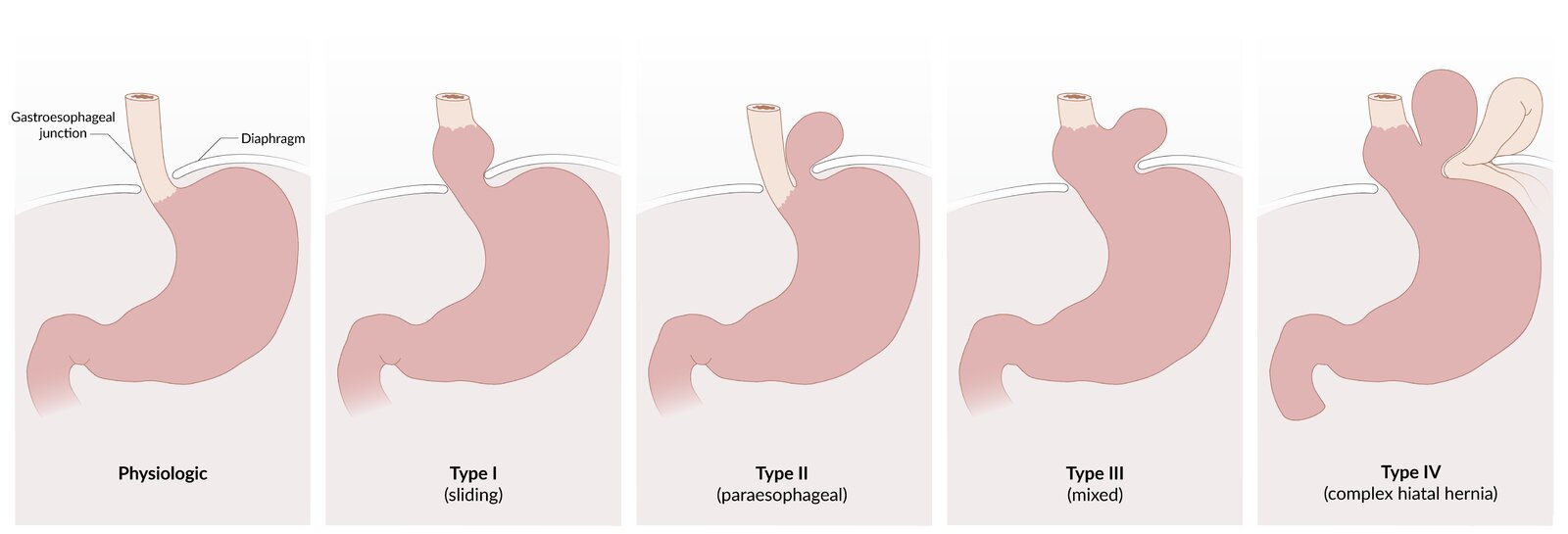
Type I (sliding): The diaphragm lies below the gastro-oesophageal junction (GOJ).
Type II (rolling/para-oesophageal): The lead point of the herniation is the gastric fundus, however there is a defect in the phreno-oesophageal membrane and the GOJ does not migrate.
Type III: A blend of I and II types.
Type IV: Large defect with pancreatic and colon herniation, among other organs.
Etiology
Congenital or acquired, such as the phreno-oesophageal ligament's weakening and increased flexibility with aging. linked to chronic oesophagitis, obesity, and gastro-oesophageal reflux disease (GORD).
Epidemiology
The most prevalent type, Type I, becomes more frequent as one ages. Five percent roll, and ninety-five percent slide.
History
lots of asymptomatic. Heartburn, indigestion, postprandial fullness, and regurgitation are signs of reflux.
Examination
Until difficulties arise, a hiatus hernia usually shows no symptoms.
Investigations
Endoscopy: Hernia diagnosis and/or associated problems (e.g., Barrett's oesophagus, ulceration, oesophagitis).
Radiology: barium swallow, meal, or CXR (large hernias can show up as a gastric air bubble behind the heart).
Via high-resolution manometry, sliding hernias can be identified.
Management
Changes to lifestyle factors: Losing weight, skipping late meals, etc.
Medical: proton pump inhibitors, H2 antagonists, and antacids.
Surgery: Only required in a small percentage of cases. The conditions that qualify for this treatment include para-oesophageal hernia, which increases the risk of strangulation and imprisonment, mass reflux, and pulmonary problems. Currently frequently fixed by laparoscopy. Hernia reduction, crural repair, either with or without prosthetic reinforcement, and antireflux fundoplication—such as Nissen's—are all part of the surgical procedure.
Because there is a chance of infection, stricture, and mesh erosion, mesh repairs are debatable.
Complications
Problems with the oesophagus: Barrett's oesophagus, erosions or ulcerations, strictures, and esophagitis.
Additional: In rare cases, para-oesophageal hernia imprisonment, strangulation, or perforation. With time, a paraoesophageal hernia may get larger and can cause breathing difficulties and an upside-down stomach when the entire stomach is inside the thoracic cavity.
After surgery: Large hiatus hernias have high recurrence rates (5–30%). Among mesh repairs are visceral erosion, stricturing, and infection.
Prognosis
Generally decent, with the most not posing serious issues. Compared to rolling hernias, sliding hernias have a better prognosis.
0 Comments
