- Published on
Surgery - Inguinal Hernia
Introduction
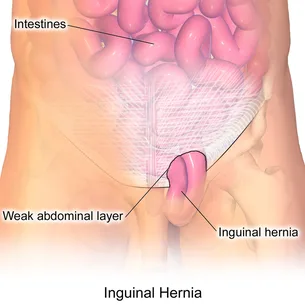
the peritoneal sac protruding abnormally through an inguinal weakness.
There are three types of hernias: indirect (60%), direct (35%), and combination (5%). Hesselbach's triangle, which is formed by the inferior epigastric vessels laterally, the inferior inguinal ligament inferiorly, and the lateral border of the rectus medially, is where direct hernias emerge. There are three types of hernias: strangulated, irreducible (confined), and reducible.
Direct: The hernial sac protrudes directly, medial to the inferior epigastric vessels, through the transversalis fascia and the posterior wall of the inguinal canal.
Indirect: The hernial sac protrudes down the inguinal canal, passing through a deep inguinal ring that has spermatic cord coverings.
Etiology
Congenital: A persistent processus vaginalis allows the contents of the abdomen to enter the inguinal canal.
acquired: "Weakness in the transversalis fascia and muscles, as well as intra-abdominal pressure."
Risk Factors
Prematurity, age, maleness, and elevated intra-abdominal pressure (e.g., persistent cough, constipation, restriction of the bladder outflow).
Epidemiology
Typical. In 4% of male births, congenital indirect inguinal hernias are present. The peak adult age range is 55–85 years. 9 to 1 in favor of men. In the UK, ten elective repairs are performed annually for every 10,000 people.
H HISTORY
either asymptomatic or the patient frequently detects a bulge or lump in the groin. may appear as a result of pain or discomfort, irreducibility, size, or signs of problems.
Examination
bulge in the groin that could spread to the scrotum. separated from femoral hernias by appearing medially and above the pubic tubercle.
Examine the patient while they are standing; a cough impulse is related to the hernia. The deep inguinal ring can be compressed to control indirect hernias. Bowel sounds from inside the hernia may be audible during auscultation.
If the victim is strangled, the hernia may be highly sensitive, irreducible, and show indications of complications such as tachycardia, pyrexia, and bowel blockage.
Investigational studies
Blood tests for an acute, painful irreducible hernia should include FBC, U&Es, CRP clotting, and G&S if surgery is going to be necessary. When intestinal ischaemia (metabolic acidosis, "lactate") is present within the hernia, ABGs may be helpful in detecting it.
Imaging: In an emergency, set up an AXR and CXR. Hernias can be diagnosed with USS or herniogram, ruling out other possible causes of groin lumps.
Management
Conservative: An inguinal truss, a type of belt that prevents the decreased hernia from protruding, may be used to treat patients who are deemed unsuitable or reluctant to have surgery.
Surgical: Simple hernias can be repaired electively. can be done while sedated in a spinal, local, epidural, or general manner. Surgical repairs come in various forms.
The repair of the mesh (Lichtenstein) involves making an oblique incision above the inguinal ligament, opening the external oblique aponeurosis, and gently releasing the spermatic cord. Herniotomies include cutting an indirect sac from the cord, opening it, and reducing its contents. The defect in the transversalis fascia is reinforced with a mesh after the sac is cut out.
This process is the most typical one. Other open methods include the Stoppa repair and the Shouldice repair, which reinforces the defect with non-absorbable sutures.
Laparoscopic mesh repair is now often performed using the transabdominal pre-peritoneal (TAPP) and completely extraperitoneal (TEP) techniques. Laparoscopic repair typically leads to an earlier recovery and return to regular activities. the preferred method for both recurring and bilateral hernias.
Emergency: Required in cases of strangulation or blocked hernia. If gangrenous bowel is present within the hernia, laparotomy with bowel resection can be necessary. In this situation, mesh insertion might not be appropriate.
Pediatric: Herniotomies are used to treat indirect hernias caused by a patent processus vaginalis (PPV). The PPV is ligated and the contents are decreased; this is not a mesh repair.
Complications
Imprisonment, strangling, obstruction of the intestine, Richter's hernia (strangulation of only a portion of the bowel wall circumference), Amyand's hernia (acute appendicitis in a right inguinal hernia), Maydl's hernia (strangulated W-shaped small-bowel loop).
following surgery: osteitis pubis, mesh infection, testicular ischaemia, pain, wound infection, hemorrhage, penile or scrotal oedema, and recurrence.
Prognosis
If I'm left alone, I tend to gradually get bigger. An annual risk of 0.3–3% is strangulation. Recurrence occurs in less than 1% of cases following surgical mesh repair, which often has satisfactory results.
Introduction
the peritoneal sac protruding abnormally through an inguinal weakness.
There are three types of hernias: indirect (60%), direct (35%), and combination (5%). Hesselbach's triangle, which is formed by the inferior epigastric vessels laterally, the inferior inguinal ligament inferiorly, and the lateral border of the rectus medially, is where direct hernias emerge. There are three types of hernias: strangulated, irreducible (confined), and reducible.
Direct: The hernial sac protrudes directly, medial to the inferior epigastric vessels, through the transversalis fascia and the posterior wall of the inguinal canal.
Indirect: The hernial sac protrudes down the inguinal canal, passing through a deep inguinal ring that has spermatic cord coverings.
Etiology
Congenital: A persistent processus vaginalis allows the contents of the abdomen to enter the inguinal canal.
acquired: "Weakness in the transversalis fascia and muscles, as well as intra-abdominal pressure."
Risk Factors
Prematurity, age, maleness, and elevated intra-abdominal pressure (e.g., persistent cough, constipation, restriction of the bladder outflow).
Epidemiology
Typical. In 4% of male births, congenital indirect inguinal hernias are present. The peak adult age range is 55–85 years. 9 to 1 in favor of men. In the UK, ten elective repairs are performed annually for every 10,000 people.
H HISTORY
either asymptomatic or the patient frequently detects a bulge or lump in the groin. may appear as a result of pain or discomfort, irreducibility, size, or signs of problems.
Examination
bulge in the groin that could spread to the scrotum. separated from femoral hernias by appearing medially and above the pubic tubercle.
Examine the patient while they are standing; a cough impulse is related to the hernia. The deep inguinal ring can be compressed to control indirect hernias. Bowel sounds from inside the hernia may be audible during auscultation.
If the victim is strangled, the hernia may be highly sensitive, irreducible, and show indications of complications such as tachycardia, pyrexia, and bowel blockage.
Investigational studies
Blood tests for an acute, painful irreducible hernia should include FBC, U&Es, CRP clotting, and G&S if surgery is going to be necessary. When intestinal ischaemia (metabolic acidosis, "lactate") is present within the hernia, ABGs may be helpful in detecting it.
Imaging: In an emergency, set up an AXR and CXR. Hernias can be diagnosed with USS or herniogram, ruling out other possible causes of groin lumps.
Management
Conservative: An inguinal truss, a type of belt that prevents the decreased hernia from protruding, may be used to treat patients who are deemed unsuitable or reluctant to have surgery.
Surgical: Simple hernias can be repaired electively. can be done while sedated in a spinal, local, epidural, or general manner. Surgical repairs come in various forms.
The repair of the mesh (Lichtenstein) involves making an oblique incision above the inguinal ligament, opening the external oblique aponeurosis, and gently releasing the spermatic cord. Herniotomies include cutting an indirect sac from the cord, opening it, and reducing its contents. The defect in the transversalis fascia is reinforced with a mesh after the sac is cut out.
This process is the most typical one. Other open methods include the Stoppa repair and the Shouldice repair, which reinforces the defect with non-absorbable sutures.
Laparoscopic mesh repair is now often performed using the transabdominal pre-peritoneal (TAPP) and completely extraperitoneal (TEP) techniques. Laparoscopic repair typically leads to an earlier recovery and return to regular activities. the preferred method for both recurring and bilateral hernias.
Emergency: Required in cases of strangulation or blocked hernia. If gangrenous bowel is present within the hernia, laparotomy with bowel resection can be necessary. In this situation, mesh insertion might not be appropriate.
Pediatric: Herniotomies are used to treat indirect hernias caused by a patent processus vaginalis (PPV). The PPV is ligated and the contents are decreased; this is not a mesh repair.
Complications
Imprisonment, strangling, obstruction of the intestine, Richter's hernia (strangulation of only a portion of the bowel wall circumference), Amyand's hernia (acute appendicitis in a right inguinal hernia), Maydl's hernia (strangulated W-shaped small-bowel loop).
following surgery: osteitis pubis, mesh infection, testicular ischaemia, pain, wound infection, hemorrhage, penile or scrotal oedema, and recurrence.
Prognosis
If I'm left alone, I tend to gradually get bigger. An annual risk of 0.3–3% is strangulation. Recurrence occurs in less than 1% of cases following surgical mesh repair, which often has satisfactory results.
0 Comments
