- Published on
Surgery - Lipomas
Introduction
Lipomas are benign adipose tissue tumors that grow slowly. Multiple contiguous lipomas that deform tissues, such as those on the buttocks or, less frequently, the neck, are referred to as lipomatosis. categorized according to its location, such as subcutaneous, subfascial, or subsynovial.
Etiology
are most frequently seen in subcutaneous fat but can appear in any type of connective tissue. Histologically, lipomas are composed of adipose cell collections that are identical to normal adipocytes and are separated into enormous lobules by thin fibrous septa.
Some chromosomal abnormalities, such as the translocation of a gene on chromosome 12, have been linked to the cause, which is unknown. Multiple painful lipomas (adiposis dolorosa/Dercum's disease) are an uncommon manifestation.
Epidemiology
All ages; uncommon in children, primarily 40–60 years old. No preference for a gender.
History
The patient feels a lump that is normally harmless and gradually growing, unless there has been trauma. In that case, it may expand and become tender due to fat necrosis.
Examination
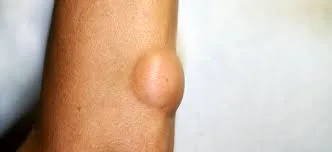
can happen anyplace that there are stores of adipose tissue, which is often the upper arm subcutaneous tissue. Variable size, frequently lobulated, typically oval or spherical (a helpful diagnostic trait). Although they are soft, non-tender, and compressible, they rarely change or become transilluminate.
Usually, the skin on top is normal. Palpable local lymph nodes are not desired.
Investigational studies
Usually not required; deeply positioned lipomas can be seen with MRI.
Management
Conservative: Shouldn't cause discomfort or deform look, it can be left alone.
Surgical: If uncomfortable or unappealing. Removeable with local anesthesia: To expose the lipoma, surgical incision is made over it; often, the lipoma can be gently milked out via the incision with minimal dissection by applying moderate pressure on the surrounding tissue. It is important to maintain hemostasis in the resultant cavity to prevent the formation of hemomas. Greater in size or located in more intricate locations, lipomas will require removal under general anesthesia.
Complications
Usually connected with their excision via surgery rather than the lipoma itself.
In the event of trauma, fat necrosis could occur.
Prognosis
Superb; lipomas typically do not progress to malignancy (liposarcomas typically develop from scratch, for example in the retroperitoneum).
Introduction
Lipomas are benign adipose tissue tumors that grow slowly. Multiple contiguous lipomas that deform tissues, such as those on the buttocks or, less frequently, the neck, are referred to as lipomatosis. categorized according to its location, such as subcutaneous, subfascial, or subsynovial.
Etiology
are most frequently seen in subcutaneous fat but can appear in any type of connective tissue. Histologically, lipomas are composed of adipose cell collections that are identical to normal adipocytes and are separated into enormous lobules by thin fibrous septa.
Some chromosomal abnormalities, such as the translocation of a gene on chromosome 12, have been linked to the cause, which is unknown. Multiple painful lipomas (adiposis dolorosa/Dercum's disease) are an uncommon manifestation.
Epidemiology
All ages; uncommon in children, primarily 40–60 years old. No preference for a gender.
History
The patient feels a lump that is normally harmless and gradually growing, unless there has been trauma. In that case, it may expand and become tender due to fat necrosis.
Examination
can happen anyplace that there are stores of adipose tissue, which is often the upper arm subcutaneous tissue. Variable size, frequently lobulated, typically oval or spherical (a helpful diagnostic trait). Although they are soft, non-tender, and compressible, they rarely change or become transilluminate.
Usually, the skin on top is normal. Palpable local lymph nodes are not desired.
Investigational studies
Usually not required; deeply positioned lipomas can be seen with MRI.
Management
Conservative: Shouldn't cause discomfort or deform look, it can be left alone.
Surgical: If uncomfortable or unappealing. Removeable with local anesthesia: To expose the lipoma, surgical incision is made over it; often, the lipoma can be gently milked out via the incision with minimal dissection by applying moderate pressure on the surrounding tissue. It is important to maintain hemostasis in the resultant cavity to prevent the formation of hemomas. Greater in size or located in more intricate locations, lipomas will require removal under general anesthesia.
Complications
Usually connected with their excision via surgery rather than the lipoma itself.
In the event of trauma, fat necrosis could occur.
Prognosis
Superb; lipomas typically do not progress to malignancy (liposarcomas typically develop from scratch, for example in the retroperitoneum).
0 Comments
