- Published on
Surgery Liver Abscess
Introduction
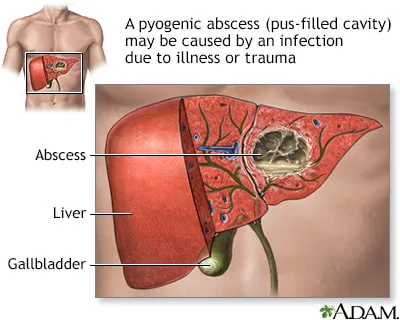
infection that causes the liver to become walled off and filled with pus.
Etiology
Escherichia coli, Klebsiellae, enterococci, Bacteroides, streptococci, and staphylococci are among the 80–85% pyrogenic bacteria. typically result from appendicitis or another cause drained via the portal circulation, such as biliary tract sepsis. less frequently linked to penetrating liver damage, post-hepatic embolization, or tumors. may be linked to an underlying immunological weakness in children.
Entamoeba histolytica, a type of amoebic gut infection, can cause secondary infections. 'Anchovy sauce' fluid, consisting of necrotic hepatocytes and trophozoites, is seen within abscesses.
Hydatid: Echinococcus granulosis, tapeworm. Grow slowly, possess millions of infectious stages known as hydatid sand (brood capsules and protoscolices), can withstand liters of fluid, and cause tissue damage through mechanical pressure.
Fungi: Aspergillus and Candida albicans. linked to immunosuppression or immunodeficiency, transplantation, and extended antibiotic exposure.
Epidemiology
Pyogenic: 0.8/100,000 is the annual incidence. In the developed world, the most prevalent age group is 60 years old.
Amoebic: The most prevalent kind globally.
Hydatid: More prevalent in nations that raise sheep.
History
fever, lethargy, anorexia, nocturnal sweats, weight loss, and diaphragmatic irritation-related hiccups.
Diaphragmatic irritation, often known as right upper quadrant or epigastric pain, may be the source of the complaint.
diarrhea, pyrexia, and jaundice of unclear cause.
Examination
Jaundice (from numerous abscesses or biliary tract abnormalities), fever (continuous or spiking).
Hepatomegaly that is tender, with atelectasis or a reactive pleural effusion on occasion visible.
Investigations
Blood: LFT (" AlkPhos, " bilirubin), " ESR, " CRP, blood cultures, amoebic and hydatid serology, moderate anemia, leukocytosis, " eosinophils in hydatid disease").
Stool microscopy and cultures: May reveal tapeworm eggs or E. histolytica.
Ultrasound: Guides aspiration and permits evaluation of the biliary tract in hypoechoic lesions that may have internal septations or debris.
On CT, abscesses usually show hypodense areas with enhanced peripheral contrast.
CXR: Elevated hemidiaphragm and right pleural effusion or atelectasis.
Goal: To identify and treat the condition.
Management
Pyogenic/Fungal: Percutaneous aspiration (under CT or ultrasonography guidance) or catheter drainage (for small to moderately sized abscesses) or, in rare cases, surgical drainage (for big or multilocular abscesses). antifungals or broad-spectrum antibiotics. underlying cause treatment.
Amoebic: Metronidazole plus luminal amoebicide (dilozanide furoate, for example).
Hydatid: Surgical excision (pericystectomy) combined with medication with albendazole or mebendazole to lower the chance of recurrence. Perforation, aspiration, injection, and respiration are all part of the PAIR procedure. Drugs may be employed in cases that are not operable.
Complications
Septic shock, allergic aftereffects, or anaphylaxis due to a ruptured hydatid cyst, as well as rupture and dissemination (such as into the biliary tract causing acute cholangitis, intrathoracic rupture, or peritonitis).
Prognosis
Pyogenic liver abscesses are sometimes lethal if left untreated; sequelae have a high death rate. Hydatid cysts may return after surgery in 10% of cases, although amoebic abscesses have a better prognosis and typically respond quickly to therapy.
Introduction
infection that causes the liver to become walled off and filled with pus.
Etiology
Escherichia coli, Klebsiellae, enterococci, Bacteroides, streptococci, and staphylococci are among the 80–85% pyrogenic bacteria. typically result from appendicitis or another cause drained via the portal circulation, such as biliary tract sepsis. less frequently linked to penetrating liver damage, post-hepatic embolization, or tumors. may be linked to an underlying immunological weakness in children.
Entamoeba histolytica, a type of amoebic gut infection, can cause secondary infections. 'Anchovy sauce' fluid, consisting of necrotic hepatocytes and trophozoites, is seen within abscesses.
Hydatid: Echinococcus granulosis, tapeworm. Grow slowly, possess millions of infectious stages known as hydatid sand (brood capsules and protoscolices), can withstand liters of fluid, and cause tissue damage through mechanical pressure.
Fungi: Aspergillus and Candida albicans. linked to immunosuppression or immunodeficiency, transplantation, and extended antibiotic exposure.
Epidemiology
Pyogenic: 0.8/100,000 is the annual incidence. In the developed world, the most prevalent age group is 60 years old.
Amoebic: The most prevalent kind globally.
Hydatid: More prevalent in nations that raise sheep.
History
fever, lethargy, anorexia, nocturnal sweats, weight loss, and diaphragmatic irritation-related hiccups.
Diaphragmatic irritation, often known as right upper quadrant or epigastric pain, may be the source of the complaint.
diarrhea, pyrexia, and jaundice of unclear cause.
Examination
Jaundice (from numerous abscesses or biliary tract abnormalities), fever (continuous or spiking).
Hepatomegaly that is tender, with atelectasis or a reactive pleural effusion on occasion visible.
Investigations
Blood: LFT (" AlkPhos, " bilirubin), " ESR, " CRP, blood cultures, amoebic and hydatid serology, moderate anemia, leukocytosis, " eosinophils in hydatid disease").
Stool microscopy and cultures: May reveal tapeworm eggs or E. histolytica.
Ultrasound: Guides aspiration and permits evaluation of the biliary tract in hypoechoic lesions that may have internal septations or debris.
On CT, abscesses usually show hypodense areas with enhanced peripheral contrast.
CXR: Elevated hemidiaphragm and right pleural effusion or atelectasis.
Goal: To identify and treat the condition.
Management
Pyogenic/Fungal: Percutaneous aspiration (under CT or ultrasonography guidance) or catheter drainage (for small to moderately sized abscesses) or, in rare cases, surgical drainage (for big or multilocular abscesses). antifungals or broad-spectrum antibiotics. underlying cause treatment.
Amoebic: Metronidazole plus luminal amoebicide (dilozanide furoate, for example).
Hydatid: Surgical excision (pericystectomy) combined with medication with albendazole or mebendazole to lower the chance of recurrence. Perforation, aspiration, injection, and respiration are all part of the PAIR procedure. Drugs may be employed in cases that are not operable.
Complications
Septic shock, allergic aftereffects, or anaphylaxis due to a ruptured hydatid cyst, as well as rupture and dissemination (such as into the biliary tract causing acute cholangitis, intrathoracic rupture, or peritonitis).
Prognosis
Pyogenic liver abscesses are sometimes lethal if left untreated; sequelae have a high death rate. Hydatid cysts may return after surgery in 10% of cases, although amoebic abscesses have a better prognosis and typically respond quickly to therapy.
0 Comments
