- Published on
Surgery - Male Circumcision
Indications
Elective: Usually carried out in infants or young boys due to cultural or religious reasons.
Penile cancer, phimosis, paraphimosis, recurrent balanoposthitis (infection of the penis and foreskin), and balanitis xerotica obliterans (lichen sclerosus of the foreskin) are among the conditions that might occur.
Hypopadias, chordee, and hidden penis are contraindications.
Emergency: Severe inflammation/infection of the penis or foreskin; in these situations, a dorsal slit of the phimotic foreskin is more secure because there's a chance of worsening the infection and achieving subpar cosmesis. Following the resolution of the infection and swelling, a formal circumcision is carried out.
Anatomy
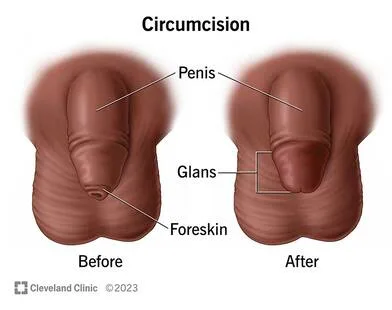
The external urethral meatus and glans are covered and shielded by the foreskin. It is made up of layers of dartos muscle and the lamina propria underneath the stratified squamous epithelium.
Boys gradually separate from the glans, and 90% of them have done so by the time they are 5 years old.
Vascular supply: The penile skin is supplied by the superficial branches of the external pudendal arteries and the dorsal artery from the internal pudendal artery. The superficial dorsal vein empties into the superficial external pudendal vein, which is the route of venous drainage.
Nerve supply: The dorsal nerve of the penis, a branch of the pudendal nerve, and the perineal nerves from S2, S3, and S4 innervate the area.
Investigational studies
No specific pre-operative investigations are required if the patient is in good health.
Action
can be carried out as a day procedure with either a local or caudal penile block or general anesthesia.
Method: The most popular method entails cutting a dorsal incision, carefully maintaining hemostasis, and then removing the foreskin. Broken absorbable sutures are used to join the penile skin to mucosa at the corona. To stop underwear from sticking to the incision, a gauze dressing is applied. It is standard procedure to send the foreskin for histological analysis.
An alternate method of circumcision called "forceps-guided" involves pulling the foreskin forward in front of the glans, clamping a forceps over it, and then excising it with a knife. After that, the inner and outer skin's sliced edges are sewn together.
Plastibel circumcision: The foreskin is introduced by dorsally cutting it, and a plastic ring is positioned underneath. After the ring is covered with a ligature, the distal tissue necroses. After a week or two, the dead foreskin and ring fall off.
Complications
Early symptoms include infection, urine retention, penile damage (such as diathermy burns), and bleeding (1%–2%).
Late: Stitches sinus, urethral fistula, chordee from excessive skin removal, recurring phimosis from inadequate circumcision, and meatal stenosis or ulcer.
Prognosis
a routine operation that is typically carried out for benign issues or cultural reasons.
Indications
Elective: Usually carried out in infants or young boys due to cultural or religious reasons.
Penile cancer, phimosis, paraphimosis, recurrent balanoposthitis (infection of the penis and foreskin), and balanitis xerotica obliterans (lichen sclerosus of the foreskin) are among the conditions that might occur.
Hypopadias, chordee, and hidden penis are contraindications.
Emergency: Severe inflammation/infection of the penis or foreskin; in these situations, a dorsal slit of the phimotic foreskin is more secure because there's a chance of worsening the infection and achieving subpar cosmesis. Following the resolution of the infection and swelling, a formal circumcision is carried out.
Anatomy
The external urethral meatus and glans are covered and shielded by the foreskin. It is made up of layers of dartos muscle and the lamina propria underneath the stratified squamous epithelium.
Boys gradually separate from the glans, and 90% of them have done so by the time they are 5 years old.
Vascular supply: The penile skin is supplied by the superficial branches of the external pudendal arteries and the dorsal artery from the internal pudendal artery. The superficial dorsal vein empties into the superficial external pudendal vein, which is the route of venous drainage.
Nerve supply: The dorsal nerve of the penis, a branch of the pudendal nerve, and the perineal nerves from S2, S3, and S4 innervate the area.
Investigational studies
No specific pre-operative investigations are required if the patient is in good health.
Action
can be carried out as a day procedure with either a local or caudal penile block or general anesthesia.
Method: The most popular method entails cutting a dorsal incision, carefully maintaining hemostasis, and then removing the foreskin. Broken absorbable sutures are used to join the penile skin to mucosa at the corona. To stop underwear from sticking to the incision, a gauze dressing is applied. It is standard procedure to send the foreskin for histological analysis.
An alternate method of circumcision called "forceps-guided" involves pulling the foreskin forward in front of the glans, clamping a forceps over it, and then excising it with a knife. After that, the inner and outer skin's sliced edges are sewn together.
Plastibel circumcision: The foreskin is introduced by dorsally cutting it, and a plastic ring is positioned underneath. After the ring is covered with a ligature, the distal tissue necroses. After a week or two, the dead foreskin and ring fall off.
Complications
Early symptoms include infection, urine retention, penile damage (such as diathermy burns), and bleeding (1%–2%).
Late: Stitches sinus, urethral fistula, chordee from excessive skin removal, recurring phimosis from inadequate circumcision, and meatal stenosis or ulcer.
Prognosis
a routine operation that is typically carried out for benign issues or cultural reasons.
0 Comments
