- Published on
Surgery - Meckel's Diverticulum
Introduction
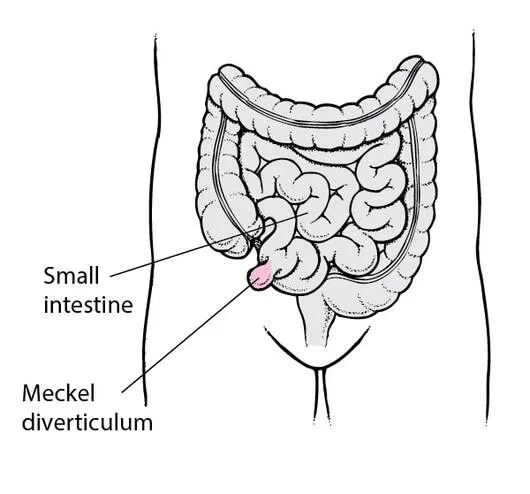
A true congenital diverticulum on the ileum's antimesenteric boundary.complies with the "occurs in 2% of the population, is 2 feet from the ileocaecal valve, and is 2 inches in length" criteria.
Etiology
The omphalomesenteric/vitelline duct in an embryo joins the developing midgut and yolk sac. In the event that the duct fails to fully recede by the fifth or seventh week, it may lead to a persistent diverticulum or, less frequently, an omphalomesenteric fistula, sinus, fibrous band, or vitelline duct cyst.
Epidemiology
The most prevalent congenital abnormality of the small intestine, affecting 2% of the population, is twice as common in men than in women. Of those affected at any age, 60% have symptoms before the age of ten.
History
The most frequent incidental or asymptomatic discovery. PR bleeding, which primarily affects children, is typically painless and appears as brick-red, dark blood mixed with excrement. It can also be severe and linked to shock. abdominal pain brought on by ulceration or diverticulitis. signs of intestinal blockage brought on by intussusception or volvulus. Mucoid or purulent discharge from the umbilicus is infrequent.
Examination
Signs may not be very strong. There may be indicators of shock when there is bleeding. Inflammatory rebound or guarding discomfort can resemble acute appendicitis symptoms.
Pathogenesis
All layers of the intestine wall are present in a genuine diverticulum, which ranges in size from 0.5 to 50 cm. It is lined with small intestinal mucosa and frequently contains heterotopic tissue (found in 60% of symptomatic cases and 5% of asymptomatic cases), most frequently stomach or pancreatic mucosa (but infrequently duodenal, jejunal, or colonic). Acid secreted by the ectopic stomach mucosa might lead to erosion or bleeding.
Investigations
Bloods: FBC, U&E, clotting, crossmatch, if bleeding.
Isotope scan: If ectopic gastric mucosa is present, a Meckel's diverticulum will absorb 99mTc-pertechnetate (a negative scan does not rule it out, though). Preoperative diagnosis presents challenges. Possibly observed in experiments using barium contrast.
In case of blockage or perforation, erect the CXR and do an AXR.
Glands angiography: When bleeding is rapid, this could not be sensitive; however, it might be helpful in cases of active bleeding.
Management
Emergency (bleeding or obstruction): address fluid and electrolyte imbalances while performing resuscitation.
Surgical: Band division and/or small bowel resection combined with surgical resection (diverticulectomy). Although excision of the incidental Meckel's diverticulum can be done laparoscopically with endostaplers, there is no strong evidence to support this procedure.
Complications
All together, these conditions carry a 6% lifetime risk: hemorrhage, intussusception, enterolith, inflammation (diverticulitis), and obstruction from an internal hernia around an omphalomesenteric band.
A Meckel's diverticulum that is imprisoned is known as a Littre's hernia. There have been reports of carcinoid tumors within Meckel's diverticulum.
Prognosis
In most cases, perform well under proper supervision.
Introduction
A true congenital diverticulum on the ileum's antimesenteric boundary.complies with the "occurs in 2% of the population, is 2 feet from the ileocaecal valve, and is 2 inches in length" criteria.
Etiology
The omphalomesenteric/vitelline duct in an embryo joins the developing midgut and yolk sac. In the event that the duct fails to fully recede by the fifth or seventh week, it may lead to a persistent diverticulum or, less frequently, an omphalomesenteric fistula, sinus, fibrous band, or vitelline duct cyst.
Epidemiology
The most prevalent congenital abnormality of the small intestine, affecting 2% of the population, is twice as common in men than in women. Of those affected at any age, 60% have symptoms before the age of ten.
History
The most frequent incidental or asymptomatic discovery. PR bleeding, which primarily affects children, is typically painless and appears as brick-red, dark blood mixed with excrement. It can also be severe and linked to shock. abdominal pain brought on by ulceration or diverticulitis. signs of intestinal blockage brought on by intussusception or volvulus. Mucoid or purulent discharge from the umbilicus is infrequent.
Examination
Signs may not be very strong. There may be indicators of shock when there is bleeding. Inflammatory rebound or guarding discomfort can resemble acute appendicitis symptoms.
Pathogenesis
All layers of the intestine wall are present in a genuine diverticulum, which ranges in size from 0.5 to 50 cm. It is lined with small intestinal mucosa and frequently contains heterotopic tissue (found in 60% of symptomatic cases and 5% of asymptomatic cases), most frequently stomach or pancreatic mucosa (but infrequently duodenal, jejunal, or colonic). Acid secreted by the ectopic stomach mucosa might lead to erosion or bleeding.
Investigations
Bloods: FBC, U&E, clotting, crossmatch, if bleeding.
Isotope scan: If ectopic gastric mucosa is present, a Meckel's diverticulum will absorb 99mTc-pertechnetate (a negative scan does not rule it out, though). Preoperative diagnosis presents challenges. Possibly observed in experiments using barium contrast.
In case of blockage or perforation, erect the CXR and do an AXR.
Glands angiography: When bleeding is rapid, this could not be sensitive; however, it might be helpful in cases of active bleeding.
Management
Emergency (bleeding or obstruction): address fluid and electrolyte imbalances while performing resuscitation.
Surgical: Band division and/or small bowel resection combined with surgical resection (diverticulectomy). Although excision of the incidental Meckel's diverticulum can be done laparoscopically with endostaplers, there is no strong evidence to support this procedure.
Complications
All together, these conditions carry a 6% lifetime risk: hemorrhage, intussusception, enterolith, inflammation (diverticulitis), and obstruction from an internal hernia around an omphalomesenteric band.
A Meckel's diverticulum that is imprisoned is known as a Littre's hernia. There have been reports of carcinoid tumors within Meckel's diverticulum.
Prognosis
In most cases, perform well under proper supervision.
0 Comments
