- Published on
Surgery - Miscellaneous Hernias
Introduction
Classifying: If the omentum, colon, or abdominal organ's blood supply is compromised, a hernia can be classified as strangulated, irreducible (incarcerated), or reducible.Amy and hers: When an inguinal hernia imprisons the appendix
Bockdalek's:Congenital diaphragmatic hernia, posterolateral, usually left-sided
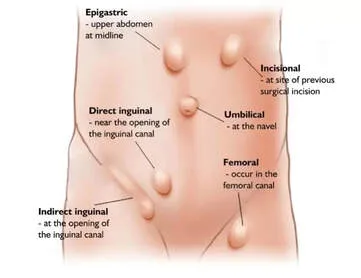
Epigastric: Herniation in the middle, between the xiphisternum and umbilicus, across the linea alba
Hernia via the larger sciatic foramen in the gluteal region
Incisional hernia: A hernia developed at the location of a prior surgical incision
Internal hernias are those that occur inside a body cavity, such as the abdomen through a paraduodenal fossa, the foramen of Winslow, or Peterson's gap after a mesenteric defect Y gastric bypass surgery
Littre's: An inguinal hernia where a Meckel's diverticum is present in the sac
Lumbar: Inferior (Petit) or superior (Grynfeltt-Lesshaft) hernias
Maydl's hernia-en-W, which has a bowel loop arranged in a W
Morgagni: An uncommon diaphragmatic hernia that develops at birth next to the xiphoid process
Obturator: Herniation via the obturator foramen, resulting in a protrusion beneath the labial folds or the scrotum
Pantaloon: Concomitant inguinal hernias, both direct and indirect
Parastomal: Herniation at the stomal opening location
Richter's:hernias in which the hernial sac only partially encloses the intestinal wall
Sciatic:less severe sciatic foramen hernia
Sliding: When an organ, such as the colon or bladder, is a component of the hernial sac
Spigelian Herniation at the level of the arcuate line, at the rectus abdominus's lateral border
The paraumbilical and umbilical
rupture via the umbilicus or in its vicinity.
Adults can get paraumbilical hernias, while babies and children can develop umbilical hernias.
Etiology
The hernial sac can arise as a result of congenital or acquired weakness in the abdominal wall and/or "intra-abdominal pressure" (such as from coughing and straining).
Epidemiology
Paraumbilical, incisional, epigastric, and parastomal hernias are comparatively common. Some varieties are less typical.
History
may show no symptoms at all or detect a painful or growing swelling.
Shear-induced hernias: large, red, and sore hernia.
Constipation, nausea, vomiting, and colicky abdominal discomfort are the initial symptoms of obstruction.
Examination
swelling that gets bigger when you cough or strain your abdomen.
usually mild and non-tender, but if imprisoned or strangulated, it could turn tender and irreducible. In an acute presentation, listen for intestinal sounds or indications of obstruction.
Investigations
may be identified by a clinical examination or, in cases when the etiology of a swelling is unclear, by imaging tests such a CT or US scan.
In the event that the abdomen is acute:
AXR imaging, to check for blockage.
Blood: ABGs (metabolic acidosis if vascular compromise to hernia contents), FBC, U&Es, clotting, G&S, and so on.
Managements
Conservative: Hernias in large necks that don't cause any symptoms might not need to be treated.
Surgical: For symptomatic, narrow-necked, or irreducible umbilical hernias as well as those that continue after the age of two, elective treatment is recommended. can be carried out using minimum or open access methods. The anatomy is established, the contents are examined and minimized, the sac is removed, and the flaw is fixed. A mesh can be used to strengthen it. In situations of strangulation, emergency surgery is indicated, and bowel resection can be necessary.
Complications
bowel blockage and hernia contents strangulation.
Prognosis
By the age of two, the majority of umbilical hernias regress. Other hernias may gradually expand and typically do not regress.
Introduction
Classifying: If the omentum, colon, or abdominal organ's blood supply is compromised, a hernia can be classified as strangulated, irreducible (incarcerated), or reducible.Amy and hers: When an inguinal hernia imprisons the appendix
Bockdalek's:Congenital diaphragmatic hernia, posterolateral, usually left-sided
Epigastric: Herniation in the middle, between the xiphisternum and umbilicus, across the linea alba
Hernia via the larger sciatic foramen in the gluteal region
Incisional hernia: A hernia developed at the location of a prior surgical incision
Internal hernias are those that occur inside a body cavity, such as the abdomen through a paraduodenal fossa, the foramen of Winslow, or Peterson's gap after a mesenteric defect Y gastric bypass surgery
Littre's: An inguinal hernia where a Meckel's diverticum is present in the sac
Lumbar: Inferior (Petit) or superior (Grynfeltt-Lesshaft) hernias
Maydl's hernia-en-W, which has a bowel loop arranged in a W
Morgagni: An uncommon diaphragmatic hernia that develops at birth next to the xiphoid process
Obturator: Herniation via the obturator foramen, resulting in a protrusion beneath the labial folds or the scrotum
Pantaloon: Concomitant inguinal hernias, both direct and indirect
Parastomal: Herniation at the stomal opening location
Richter's:hernias in which the hernial sac only partially encloses the intestinal wall
Sciatic:less severe sciatic foramen hernia
Sliding: When an organ, such as the colon or bladder, is a component of the hernial sac
Spigelian Herniation at the level of the arcuate line, at the rectus abdominus's lateral border
The paraumbilical and umbilical
rupture via the umbilicus or in its vicinity.
Adults can get paraumbilical hernias, while babies and children can develop umbilical hernias.
Etiology
The hernial sac can arise as a result of congenital or acquired weakness in the abdominal wall and/or "intra-abdominal pressure" (such as from coughing and straining).
Epidemiology
Paraumbilical, incisional, epigastric, and parastomal hernias are comparatively common. Some varieties are less typical.
History
may show no symptoms at all or detect a painful or growing swelling.
Shear-induced hernias: large, red, and sore hernia.
Constipation, nausea, vomiting, and colicky abdominal discomfort are the initial symptoms of obstruction.
Examination
swelling that gets bigger when you cough or strain your abdomen.
usually mild and non-tender, but if imprisoned or strangulated, it could turn tender and irreducible. In an acute presentation, listen for intestinal sounds or indications of obstruction.
Investigations
may be identified by a clinical examination or, in cases when the etiology of a swelling is unclear, by imaging tests such a CT or US scan.
In the event that the abdomen is acute:
AXR imaging, to check for blockage.
Blood: ABGs (metabolic acidosis if vascular compromise to hernia contents), FBC, U&Es, clotting, G&S, and so on.
Managements
Conservative: Hernias in large necks that don't cause any symptoms might not need to be treated.
Surgical: For symptomatic, narrow-necked, or irreducible umbilical hernias as well as those that continue after the age of two, elective treatment is recommended. can be carried out using minimum or open access methods. The anatomy is established, the contents are examined and minimized, the sac is removed, and the flaw is fixed. A mesh can be used to strengthen it. In situations of strangulation, emergency surgery is indicated, and bowel resection can be necessary.
Complications
bowel blockage and hernia contents strangulation.
Prognosis
By the age of two, the majority of umbilical hernias regress. Other hernias may gradually expand and typically do not regress.
0 Comments
