- Published on
Surgery - Perianal fistula and abscess
Introduction
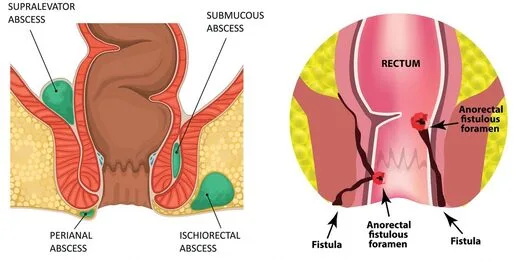
A collection of pus in the perianal area is called a perianal abscess.
A perianal fistula is an aberrant, persistently infected channel that connects the rectum or anal canal to the skin of the perianal region.
Types of abscesses: Submucous, subcutaneous, intersphincteric, ischiorectal, and pelvirectal abscesses are categorized based on their location.
Types of fistulas: According to Park, there are five different types of sphincters: superficial, transsphincteric, suprasphincteric, extrasphincteric, or low anal (below puborectalis), high anal (at or above puborectalis), and pelvirectal (including levator ani).
Etiology
Superinfection that extends to perianal tissues is caused by obstruction and stasis of the anal crypt glands. Once an abscess discharges or is removed, fistulae may form. They can also result in multiple perineal fistulae (pepperpot perineum), a consequence of Crohn's disease.
perhaps linked to malignancy (rectal cancer) or diabetes.
Epidemiology
peak incidence in the third to fourth decade, common. greater in men.
History
persistent throbbing discomfort in the lower leg. Fistulae cause sporadic discharge that may be blood- or mucus-stained close to the anal area.
Examination
localized, painful swelling of the perianal region or a little skin incision with discharge close to the anus, which is indicative of a fistula opening. One may feel a region of induration on PR that corresponds to the fistula tract or abscess. Not usually feasible because of sphincter spasm or discomfort.
It can be necessary to do an examination while sedated.
The Goodsall Rule: As a general guideline, locate the internal fistula opening based on where the external fistula opening is located. The fistula enters the anal canal directly and radially if the external orifice is ahead of the anal canal. The fistula tract takes a curved route and opens internally at the posterior midline if the external opening is posterior to the anal canal.
Investigations
Blood: if pyrexial, blood cultures, FBC, CRP, and ESR.
When it comes to intricate fistulae, MRI is quite helpful in enabling a thorough examination of the tracts. enables the planning of surgery to guarantee total excision.
Less helpful than MRI, endoanal ultrasound is nevertheless utilized.
Management
Surgical: Necessitates general anesthesia for surgical care.
Open drainage of an abscess: An incision and drainage operation is the most typical method. Over the abscess, a cruciate incision is created. Locus disintegrates and pus is extracted. After that, the cavity is softly packed and irrigated.
Laying open of fistula: The tract is gently explored using a probe. To show the internal opening, inject methylene blue or hydrogen peroxide into the exterior orifice.
Low fistulae: A fistulotomy is used to treat the condition by opening and cutting the tract, curing away granulation tissue, and enabling secondary intention healing.
To prevent the anal sphincter from being harmed, extreme caution must be used.
High fistulae: Surgical solutions are available for fistulae affecting the upper half of the sphincter complex, where muscle division would result in incontinence. A non-absorbable suture called a seton is inserted through the fistula tract to allow sepsis to drain and to progressively cut through the sphincter while maintaining continence. Advancement flap: A mucosal advancement flap closes the internal aperture after the exterior portion of the fistula is removed.
Fistula plug: To promote closure, a xenograft composed of pig intestinal submucosa is placed into the tract. Fibrin glue: Fibrin glue obliterates the fistula tract. Poor long-term outcomes.
Antibiotics: Surgery is the preferred method of treating abscesses; however, if cellulitis is present, antibiotics may be helpful.
Complications
severe sepsis if left untreated, recurrence. incontinence and harm to the anal sphincter following fistula surgery.
Prognosis
high rate of recurrence without total removal. Recurrence rates with advancement flaps for high fistulae range from 0% to 63%.
Introduction
A collection of pus in the perianal area is called a perianal abscess.
A perianal fistula is an aberrant, persistently infected channel that connects the rectum or anal canal to the skin of the perianal region.
Types of abscesses: Submucous, subcutaneous, intersphincteric, ischiorectal, and pelvirectal abscesses are categorized based on their location.
Types of fistulas: According to Park, there are five different types of sphincters: superficial, transsphincteric, suprasphincteric, extrasphincteric, or low anal (below puborectalis), high anal (at or above puborectalis), and pelvirectal (including levator ani).
Etiology
Superinfection that extends to perianal tissues is caused by obstruction and stasis of the anal crypt glands. Once an abscess discharges or is removed, fistulae may form. They can also result in multiple perineal fistulae (pepperpot perineum), a consequence of Crohn's disease.
perhaps linked to malignancy (rectal cancer) or diabetes.
Epidemiology
peak incidence in the third to fourth decade, common. greater in men.
History
persistent throbbing discomfort in the lower leg. Fistulae cause sporadic discharge that may be blood- or mucus-stained close to the anal area.
Examination
localized, painful swelling of the perianal region or a little skin incision with discharge close to the anus, which is indicative of a fistula opening. One may feel a region of induration on PR that corresponds to the fistula tract or abscess. Not usually feasible because of sphincter spasm or discomfort.
It can be necessary to do an examination while sedated.
The Goodsall Rule: As a general guideline, locate the internal fistula opening based on where the external fistula opening is located. The fistula enters the anal canal directly and radially if the external orifice is ahead of the anal canal. The fistula tract takes a curved route and opens internally at the posterior midline if the external opening is posterior to the anal canal.
Investigations
Blood: if pyrexial, blood cultures, FBC, CRP, and ESR.
When it comes to intricate fistulae, MRI is quite helpful in enabling a thorough examination of the tracts. enables the planning of surgery to guarantee total excision.
Less helpful than MRI, endoanal ultrasound is nevertheless utilized.
Management
Surgical: Necessitates general anesthesia for surgical care.
Open drainage of an abscess: An incision and drainage operation is the most typical method. Over the abscess, a cruciate incision is created. Locus disintegrates and pus is extracted. After that, the cavity is softly packed and irrigated.
Laying open of fistula: The tract is gently explored using a probe. To show the internal opening, inject methylene blue or hydrogen peroxide into the exterior orifice.
Low fistulae: A fistulotomy is used to treat the condition by opening and cutting the tract, curing away granulation tissue, and enabling secondary intention healing.
To prevent the anal sphincter from being harmed, extreme caution must be used.
High fistulae: Surgical solutions are available for fistulae affecting the upper half of the sphincter complex, where muscle division would result in incontinence. A non-absorbable suture called a seton is inserted through the fistula tract to allow sepsis to drain and to progressively cut through the sphincter while maintaining continence. Advancement flap: A mucosal advancement flap closes the internal aperture after the exterior portion of the fistula is removed.
Fistula plug: To promote closure, a xenograft composed of pig intestinal submucosa is placed into the tract. Fibrin glue: Fibrin glue obliterates the fistula tract. Poor long-term outcomes.
Antibiotics: Surgery is the preferred method of treating abscesses; however, if cellulitis is present, antibiotics may be helpful.
Complications
severe sepsis if left untreated, recurrence. incontinence and harm to the anal sphincter following fistula surgery.
Prognosis
high rate of recurrence without total removal. Recurrence rates with advancement flaps for high fistulae range from 0% to 63%.
0 Comments
