- Published on
Surgery - Rectal Prolapse
Introduction
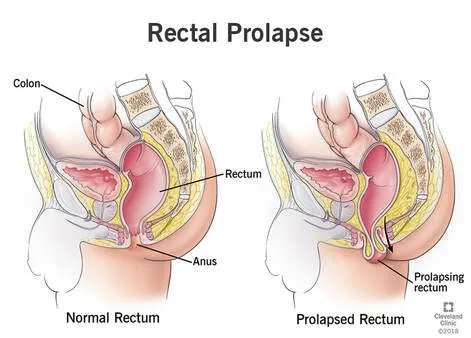
the whole thickness rectal wall or aberrant rectal mucosa protrusion through the anus.
Etiology
Incomplete prolapse: This condition, which affects only the mucosa and can occur in both adults and children, is linked to hemorrhoids, constipation, and prolonged straining.
Total prolapse: primarily affects adults and involves the entire rectal wall. It is linked to weak pelvic and anal muscles. Constipation, aging, persistent straining, paralysis of the sphincter, neurological disorders such multiple sclerosis, and childhood cystic fibrosis.
Epidemiology
comparatively typical. There are two peaks: in younger children (male: female) and in older people (female: male is 6: 1).
History
Bulging anal mass that could need to be replaced digitally. hemorrhage from PR related to constipation, faecal incontinence, or mucus passage. may show up as an emergency if the prolapse is strangulated or intractable.
Examination
Straining may reveal the prolapse, which ranges in intensity from protruding rectal mucosa to a full-blown rectal prolapse (if >5 cm, always a complete prolapse). may exhibit necrosis or develop ulcers if the vascular supply is impaired.
lower tone of the anal sphincter.
Investigations
Imaging methods include barium enema, defaecating proctogram, and protosigmoidoscopy.
Further: Pudendal nerve research, anal sphincter manometry.
Sweat chloride test: Approximately 10% of children will test positive for cystic fibrosis.
Management
Conservative: Using a lot of laxatives to treat constipation. A high-fiber diet combined with constipation medication is typically adequate for children.
Emergency: If sufficient analgesia is provided, acute prolapse can be manually controlled. Patients will likely have considerable edema and should be treated with ice packs topically before attempting manual reduction. If the bowel is gangrenous, a rectosigmoidectomy will be necessary.
Surgical: Incomplete prolapse: Mucosal banding, hemorrhoidectomy, or submucosal injection sclerotherapy using phenol in oil are possible options.
Total prolapse: Laparoscopic, abdominal, or perineal methods of surgical repair; for example, Ripstein rectopexy, in which the rectum is mobilized and fixed to the sacrum using nonabsorbable sutures. Resection rectopexy, also known as Delorme's operation, involves plication of the rectal muscle beneath the excised rectal mucosa. In certain situations, anal sphincter repair may be necessary. The Altemeir surgery involves coloanal anastomosis and the resection of the prolapsed rectum and sigmoid colon from below.
Complications
incontinence, rectal bleeding, and mucosal ulcers. Rarely, prolapsed colon necrosis and strangulation.
Prognosis
Children typically experience spontaneous resolution. Generally favorable in adults with appropriate treatment, although there is a 15% recurrence rate.
Introduction
the whole thickness rectal wall or aberrant rectal mucosa protrusion through the anus.
Etiology
Incomplete prolapse: This condition, which affects only the mucosa and can occur in both adults and children, is linked to hemorrhoids, constipation, and prolonged straining.
Total prolapse: primarily affects adults and involves the entire rectal wall. It is linked to weak pelvic and anal muscles. Constipation, aging, persistent straining, paralysis of the sphincter, neurological disorders such multiple sclerosis, and childhood cystic fibrosis.
Epidemiology
comparatively typical. There are two peaks: in younger children (male: female) and in older people (female: male is 6: 1).
History
Bulging anal mass that could need to be replaced digitally. hemorrhage from PR related to constipation, faecal incontinence, or mucus passage. may show up as an emergency if the prolapse is strangulated or intractable.
Examination
Straining may reveal the prolapse, which ranges in intensity from protruding rectal mucosa to a full-blown rectal prolapse (if >5 cm, always a complete prolapse). may exhibit necrosis or develop ulcers if the vascular supply is impaired.
lower tone of the anal sphincter.
Investigations
Imaging methods include barium enema, defaecating proctogram, and protosigmoidoscopy.
Further: Pudendal nerve research, anal sphincter manometry.
Sweat chloride test: Approximately 10% of children will test positive for cystic fibrosis.
Management
Conservative: Using a lot of laxatives to treat constipation. A high-fiber diet combined with constipation medication is typically adequate for children.
Emergency: If sufficient analgesia is provided, acute prolapse can be manually controlled. Patients will likely have considerable edema and should be treated with ice packs topically before attempting manual reduction. If the bowel is gangrenous, a rectosigmoidectomy will be necessary.
Surgical: Incomplete prolapse: Mucosal banding, hemorrhoidectomy, or submucosal injection sclerotherapy using phenol in oil are possible options.
Total prolapse: Laparoscopic, abdominal, or perineal methods of surgical repair; for example, Ripstein rectopexy, in which the rectum is mobilized and fixed to the sacrum using nonabsorbable sutures. Resection rectopexy, also known as Delorme's operation, involves plication of the rectal muscle beneath the excised rectal mucosa. In certain situations, anal sphincter repair may be necessary. The Altemeir surgery involves coloanal anastomosis and the resection of the prolapsed rectum and sigmoid colon from below.
Complications
incontinence, rectal bleeding, and mucosal ulcers. Rarely, prolapsed colon necrosis and strangulation.
Prognosis
Children typically experience spontaneous resolution. Generally favorable in adults with appropriate treatment, although there is a 15% recurrence rate.
0 Comments
