- Published on
Surgery - Splenic Rupture
Introduction
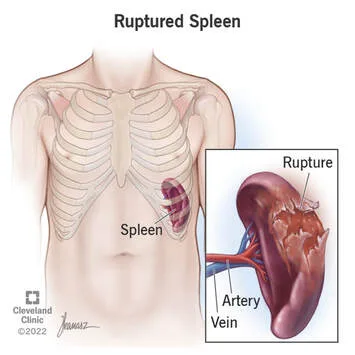
Splenic rupture carrying a significant risk of intra-abdominal bleeding.
The American Association for the Surgery of Trauma's severity rating
Grade 1: Haematoma (less than 10% of surface area) or minor subcapsular tear (less than 1 cm)
Grade 2: Subcapsular hemorrhage that is not growing 10–50% of the surface area, with an intraparenchymal hemorrhage less than 5 cm in diameter
Grade 3: Ruptured subcapsular or intraparenchymal hemorrhage, laceration >3 cm or involving trabecular arteries, and subcapsular hemorrhage greater than 50% of surface area
Grade 4: Significant devascularization and laceration involving segmental or hilar vessels
Grade 5: Devascularized spleen with hilar vascular damage and shattered spleen
Etiology
Most often as a result of injuries from fast deceleration or non-penetrating trauma. connected to additional traumatic internal organ damage, such as rib fractures, and injuries to the pancreas, liver, kidney, and diaphragm. Splenomegaly and associated conditions such leukemia, infectious mononucleosis, and malaria "the risk of rupture from even small trauma."
Epidemiology
quite prevalent; up to 25% of instances involving major trauma have some degree of it.
History
Past experiences with blunt trauma. Abdominal pain that may be referred to the left shoulder tip (Kehr's sign) and may be localized or diffuse to the left flank.
Examination
discomfort, guarding, and stiffness in the abdomen (generalized or limited to the left flank).
symptoms of shock, such as tachycardia and hypotension.
Due to the creation of a subcapsular hemorrhage that eventually ruptures due to its expansion in size, there may be a delay in rupture for several days after the trauma.
Investigations
Blood: clotting, crossmatch, FBC, U&Es, and LFTs.
Ultrasound: Targeted sonography evaluation for trauma to identify any fluid in the peritoneal cavity that can indicate an intra-abdominal hemorrhage.
CT scan: To detect damage to other organs and the spleen.
CXR: May reveal a left pulmonary contusion, diaphragmatic rupture, or rib fractures.
Due to the availability of FAST and CT scanning, diagnostic peritoneal lavage—which detects free intraperitoneal blood—is rarely carried out.
Management
based on the degree of injury and the heamodynamic condition.
Wide-bore IV access, fluids, transfusion if required, and avoiding overinfusion (permissive hypotension may be tolerated) are the components of resuscitation. First grade and up to Grade 2: Exercise cautious management, closely observe, and reassess frequently. Take into account using interventional radiology procedures to sever a bleeding site. Grade 3: Laparotomy and perhaps a splenectomy or splenorrhaphy. Grades 4 and 5: partial excision.
Immunization against meningococcal (Men C), pneumococcal, and hemophilus organisms should be administered following surgery. Up until the age of 15, patients receive antibiotic prophylaxis as well, and they are advised to keep an antibiotic supply at home in case of infection.
Complications
From injury: bleeding, demise.
bleeding, sepsis following splenectomy, "risk of encapsulated organism infections, thrombotic vascular event (splenic/splanchnic venous thrombosis), pancreatitis, subphrenic abscess, gastric distension, and focal gastric necrosis" are among the consequences of splenectomy.
Rebleeding or thrombosis of the residual spleen from splenorrhaphy.
Prognosis
75% fatality rate in the absence of treatment. The range of mean mortality with therapy is 3% to 23%.
Introduction
Splenic rupture carrying a significant risk of intra-abdominal bleeding.
The American Association for the Surgery of Trauma's severity rating
Grade 1: Haematoma (less than 10% of surface area) or minor subcapsular tear (less than 1 cm)
Grade 2: Subcapsular hemorrhage that is not growing 10–50% of the surface area, with an intraparenchymal hemorrhage less than 5 cm in diameter
Grade 3: Ruptured subcapsular or intraparenchymal hemorrhage, laceration >3 cm or involving trabecular arteries, and subcapsular hemorrhage greater than 50% of surface area
Grade 4: Significant devascularization and laceration involving segmental or hilar vessels
Grade 5: Devascularized spleen with hilar vascular damage and shattered spleen
Etiology
Most often as a result of injuries from fast deceleration or non-penetrating trauma. connected to additional traumatic internal organ damage, such as rib fractures, and injuries to the pancreas, liver, kidney, and diaphragm. Splenomegaly and associated conditions such leukemia, infectious mononucleosis, and malaria "the risk of rupture from even small trauma."
Epidemiology
quite prevalent; up to 25% of instances involving major trauma have some degree of it.
History
Past experiences with blunt trauma. Abdominal pain that may be referred to the left shoulder tip (Kehr's sign) and may be localized or diffuse to the left flank.
Examination
discomfort, guarding, and stiffness in the abdomen (generalized or limited to the left flank).
symptoms of shock, such as tachycardia and hypotension.
Due to the creation of a subcapsular hemorrhage that eventually ruptures due to its expansion in size, there may be a delay in rupture for several days after the trauma.
Investigations
Blood: clotting, crossmatch, FBC, U&Es, and LFTs.
Ultrasound: Targeted sonography evaluation for trauma to identify any fluid in the peritoneal cavity that can indicate an intra-abdominal hemorrhage.
CT scan: To detect damage to other organs and the spleen.
CXR: May reveal a left pulmonary contusion, diaphragmatic rupture, or rib fractures.
Due to the availability of FAST and CT scanning, diagnostic peritoneal lavage—which detects free intraperitoneal blood—is rarely carried out.
Management
based on the degree of injury and the heamodynamic condition.
Wide-bore IV access, fluids, transfusion if required, and avoiding overinfusion (permissive hypotension may be tolerated) are the components of resuscitation. First grade and up to Grade 2: Exercise cautious management, closely observe, and reassess frequently. Take into account using interventional radiology procedures to sever a bleeding site. Grade 3: Laparotomy and perhaps a splenectomy or splenorrhaphy. Grades 4 and 5: partial excision.
Immunization against meningococcal (Men C), pneumococcal, and hemophilus organisms should be administered following surgery. Up until the age of 15, patients receive antibiotic prophylaxis as well, and they are advised to keep an antibiotic supply at home in case of infection.
Complications
From injury: bleeding, demise.
bleeding, sepsis following splenectomy, "risk of encapsulated organism infections, thrombotic vascular event (splenic/splanchnic venous thrombosis), pancreatitis, subphrenic abscess, gastric distension, and focal gastric necrosis" are among the consequences of splenectomy.
Rebleeding or thrombosis of the residual spleen from splenorrhaphy.
Prognosis
75% fatality rate in the absence of treatment. The range of mean mortality with therapy is 3% to 23%.
0 Comments
