- Published on
Surgery - Suturing
Indications
surgical cuts or wounds that need to be closed. In order to promote quick healing and optimal cosmesis, the goal is to align the edges of the wounds without stress.
Anatomy
The epidermis, or outside keratinized epithelium, the dermis, or underlying fibroelastic layer containing blood vessels, lymphatics, and nerves, and the subcutaneous tissue, or deep layer of varying thickness made up primarily of adipose tissue, are the three layers that make up the skin.
Investigations
Prior to surgery: history of allergies to skin prep or antibiotics; informed consent. Proper cleansing and dressing of severe injuries. It is imperative to take into account one's tetanus status and administer booster shots or immunoglobulins as necessary, along with vaccinations. If there is a chance of a foreign body, such glass, or a related bone damage, radiographs can be required.
Advice on wound care, analgesics, dressings, and antibiotics only when necessary follow surgery.
Procedure
Simple cuts may mostly be closed.It is advisable to refer patients with more complicated injuries—such as those involving the face or other traumas, such tendon damage—to the proper specialists, like plastic surgeons. Antibiotics should be used if linked to a fracture, namely an open fracture. Primary closure is avoided and antibiotics are used for bite wounds, particularly those resulting from bites on humans.
Local anaesthesia: After skin preparation, the area surrounding the wound is infused with local anesthetic, being sure to aspirate before injecting to prevent intravascular injection. It is never advisable to inject local anesthetic combined with adrenaline close to fingers or in regions like the nose, ear, or penis.
Examining and cleaning the wound: The wound is carefully cleaned, irrigated, and inspected. It could need to be scrubbed if it's dirty. The wound is examined to look for any underlying injuries, such as to tendons.
Sutures can be categorized as either natural or synthetic, absorbable or non-absorbable, and as single or multifilament (braided). Subcutaneous absorbable sutures are utilized when suturing deep tissues. In traumatic wounds, non-absorbable sutures are always employed. This prevents the entire wound from being compromised in the event that an infection occurs, allowing for the removal of one or a small number.
In surgical wounds, absorbable sutures are frequently utilized. A finer 5–0 or 6–0 stitch for the face, 3–0 or 4–0 for the trunk and limbs, and 2–0 for the scalp are the types of sutures that are utilized depending on the place.
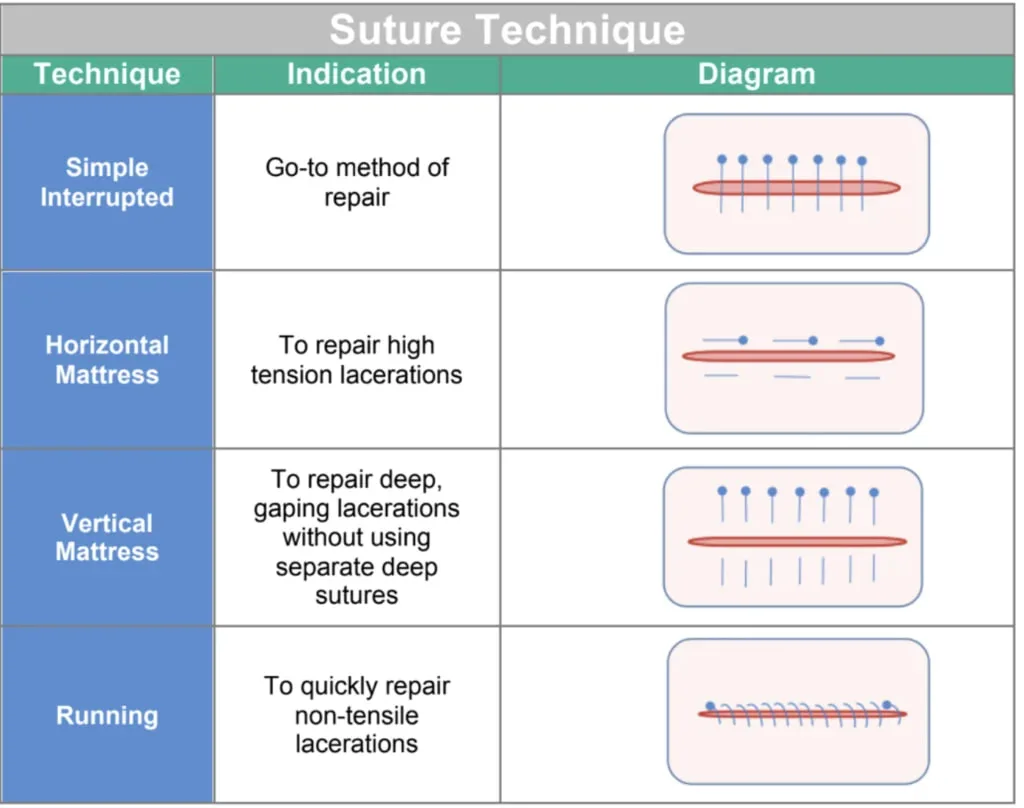
Suturing: For a diagrammatic description of types, see to Fig. 26. When using aseptic method, wounds should be properly prepped and draped. Simple discontinuous (broken) sutures are frequently employed. For deeper wounds, vertical mattress stitches may be employed because they allow for adequate skin edge eversion.
Good cosmesis and close wound approximation are made possible by subcuticular suturing.
Dressing: The wound is covered with a dry dressing. Only as long as necessary is the length of time that stitches are left in place to maintain the incision. Face stitches come out in a matter of two to five days, but sutures on the limbs and abdominal wall typically take ten days to fall out.
Complications
Inadequate aesthetics: sutures may serve as a breeding ground for infection, abscess, granuloma, sinus, wound dehiscence, and scarring.
Indications
surgical cuts or wounds that need to be closed. In order to promote quick healing and optimal cosmesis, the goal is to align the edges of the wounds without stress.
Anatomy
The epidermis, or outside keratinized epithelium, the dermis, or underlying fibroelastic layer containing blood vessels, lymphatics, and nerves, and the subcutaneous tissue, or deep layer of varying thickness made up primarily of adipose tissue, are the three layers that make up the skin.
Investigations
Prior to surgery: history of allergies to skin prep or antibiotics; informed consent. Proper cleansing and dressing of severe injuries. It is imperative to take into account one's tetanus status and administer booster shots or immunoglobulins as necessary, along with vaccinations. If there is a chance of a foreign body, such glass, or a related bone damage, radiographs can be required.
Advice on wound care, analgesics, dressings, and antibiotics only when necessary follow surgery.
Procedure
Simple cuts may mostly be closed.It is advisable to refer patients with more complicated injuries—such as those involving the face or other traumas, such tendon damage—to the proper specialists, like plastic surgeons. Antibiotics should be used if linked to a fracture, namely an open fracture. Primary closure is avoided and antibiotics are used for bite wounds, particularly those resulting from bites on humans.
Local anaesthesia: After skin preparation, the area surrounding the wound is infused with local anesthetic, being sure to aspirate before injecting to prevent intravascular injection. It is never advisable to inject local anesthetic combined with adrenaline close to fingers or in regions like the nose, ear, or penis.
Examining and cleaning the wound: The wound is carefully cleaned, irrigated, and inspected. It could need to be scrubbed if it's dirty. The wound is examined to look for any underlying injuries, such as to tendons.
Sutures can be categorized as either natural or synthetic, absorbable or non-absorbable, and as single or multifilament (braided). Subcutaneous absorbable sutures are utilized when suturing deep tissues. In traumatic wounds, non-absorbable sutures are always employed. This prevents the entire wound from being compromised in the event that an infection occurs, allowing for the removal of one or a small number.
In surgical wounds, absorbable sutures are frequently utilized. A finer 5–0 or 6–0 stitch for the face, 3–0 or 4–0 for the trunk and limbs, and 2–0 for the scalp are the types of sutures that are utilized depending on the place.
Suturing: For a diagrammatic description of types, see to Fig. 26. When using aseptic method, wounds should be properly prepped and draped. Simple discontinuous (broken) sutures are frequently employed. For deeper wounds, vertical mattress stitches may be employed because they allow for adequate skin edge eversion.
Good cosmesis and close wound approximation are made possible by subcuticular suturing.
Dressing: The wound is covered with a dry dressing. Only as long as necessary is the length of time that stitches are left in place to maintain the incision. Face stitches come out in a matter of two to five days, but sutures on the limbs and abdominal wall typically take ten days to fall out.
Complications
Inadequate aesthetics: sutures may serve as a breeding ground for infection, abscess, granuloma, sinus, wound dehiscence, and scarring.
0 Comments
