- Published on
Surgery - Thyroid Cancer
Overview
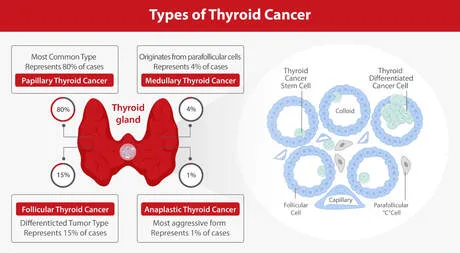
Thyroid gland cancer; varieties include anaplastic, follicular, medullary, and papillary tumors.
Risk Factors
Radiation exposure throughout childhood (papillary tumors). connected to p53 gene alterations and the MAPK pathway. Thyroid cancers in the medullary gland that are linked to MEN syndrome type IIa or IIb (20% of cases) may run in families. Thyroiditis caused by Hashimoto's is linked to lymphoma.
Epidemiology
most prevalent endocrine cancer. 8.2/100,000 is the increase in incidence. The ratio of women to men is 3:1.
Anaplastic tumors usually develop in older age groups: papillary 20–40 years, follicular 40–50 years.
History
A nodule, lump, or thyroid that grows slowly.
The patient can report having trouble swallowing or having a raspy voice.
Examination
a generalized thyroid enlargement or a palpable nodule. It is important to detect cancer if the cervical nodes are enlarged. Typically, the patient has euthyroidism.
Investigation
Blood: TFT (thyroglobulin, a tumor marker for papillary and follicular tumors, if hyperthyroid, thyroid nodule is less likely to be malignant), bone profile, and calcitonin, a tumor marker for medullary cancer.
Histological diagnosis is possible by core needle biopsy guided by ultrasonography or FNA cytology (FNAC). If a cervical lymph node is swollen, a lymph node biopsy may be necessary.
Imaging methods include bone scans, CT and/or MRI staging, ultrasound, and isotope scanning.
Histology: & Seventy percent of papillary adenocarcinomas are multi-focal, with "orphan Annie"—pale, empty, and grooved nuclei—being one of their hallmarks. They spread quickly and infiltrate lymphatics.
& 15% of encapsulated follicular adenocarcinomas disseminate hemorrhagically to the lung and bone. Since vascular and/or capsular invasion determines malignancy, FNAC cannot diagnose follicular tumors.
& Five to ten percent of medullary adenocarcinomas are strongly differentiated, originating from C cells that secrete parafollicular calcitonin.
& Anaplastic carcinomas are very aggressive, pleomorphic, undifferenciated tumors that stain for cytokeratins.
& Lymphomas typically include diffuse B cells and are uncommon (2.5% of extra nodal lymphomas).
Surgical management involves a total thyroidectomy along with block dissection of any lymph nodes that are impacted. For papillary tumors that are well-localized, a subtotal thyroid lobectomy may be necessary. Since anaplastic tumors are typically hard-fixed masses, the sole treatment options may be tracheal compression and local debulking.
Medical: Thyroxine medication to decrease remaining tumor cells in papillary and follicular tumors (which may be activated by TSH) and prevent hypothyroidism after surgery. Chemotherapy with doxorubicin is used for anaplastic tumors.
Radiological: 131I-radioiodine therapy for metastases, recurrences, and papillary tumors that extend outside of the capsule. External radiation therapy for regional relapses.
Tumors that are anaplastic are not very responsive.
Complications
Dysphonia, hoarseness from involvement of the recurrent laryngeal nerve, airway obstruction, tracheomalacia from compression, and dysphagia are symptoms of the condition.
Following surgery, there was laryngeal oedema, hypoparathyroidism, hypothyroidism, recurrent laryngeal nerve injury, and superior laryngeal nerve paresis.
Prognosis: Tumor type, size, and stage are significant variables. Overall survival for medullary carcinomas is 90% (node negative) and 50% (node positive) after 5 years; this survival is lowest in men and individuals over 50. Follic carcinomas have an overall survival of 85% after 5 years. The best patients for papillary carcinomas are those under 40 with tumors smaller than 1.5 cm. Within the capsule, lymphomas have a 5-year survival rate of 85%; however, with local dissemination, this number lowers to 40%. The prognosis for anaplastic carcinomas is extremely bad.
Overview
Thyroid gland cancer; varieties include anaplastic, follicular, medullary, and papillary tumors.
Risk Factors
Radiation exposure throughout childhood (papillary tumors). connected to p53 gene alterations and the MAPK pathway. Thyroid cancers in the medullary gland that are linked to MEN syndrome type IIa or IIb (20% of cases) may run in families. Thyroiditis caused by Hashimoto's is linked to lymphoma.
Epidemiology
most prevalent endocrine cancer. 8.2/100,000 is the increase in incidence. The ratio of women to men is 3:1.
Anaplastic tumors usually develop in older age groups: papillary 20–40 years, follicular 40–50 years.
History
A nodule, lump, or thyroid that grows slowly.
The patient can report having trouble swallowing or having a raspy voice.
Examination
a generalized thyroid enlargement or a palpable nodule. It is important to detect cancer if the cervical nodes are enlarged. Typically, the patient has euthyroidism.
Investigation
Blood: TFT (thyroglobulin, a tumor marker for papillary and follicular tumors, if hyperthyroid, thyroid nodule is less likely to be malignant), bone profile, and calcitonin, a tumor marker for medullary cancer.
Histological diagnosis is possible by core needle biopsy guided by ultrasonography or FNA cytology (FNAC). If a cervical lymph node is swollen, a lymph node biopsy may be necessary.
Imaging methods include bone scans, CT and/or MRI staging, ultrasound, and isotope scanning.
Histology: & Seventy percent of papillary adenocarcinomas are multi-focal, with "orphan Annie"—pale, empty, and grooved nuclei—being one of their hallmarks. They spread quickly and infiltrate lymphatics.
& 15% of encapsulated follicular adenocarcinomas disseminate hemorrhagically to the lung and bone. Since vascular and/or capsular invasion determines malignancy, FNAC cannot diagnose follicular tumors.
& Five to ten percent of medullary adenocarcinomas are strongly differentiated, originating from C cells that secrete parafollicular calcitonin.
& Anaplastic carcinomas are very aggressive, pleomorphic, undifferenciated tumors that stain for cytokeratins.
& Lymphomas typically include diffuse B cells and are uncommon (2.5% of extra nodal lymphomas).
Surgical management involves a total thyroidectomy along with block dissection of any lymph nodes that are impacted. For papillary tumors that are well-localized, a subtotal thyroid lobectomy may be necessary. Since anaplastic tumors are typically hard-fixed masses, the sole treatment options may be tracheal compression and local debulking.
Medical: Thyroxine medication to decrease remaining tumor cells in papillary and follicular tumors (which may be activated by TSH) and prevent hypothyroidism after surgery. Chemotherapy with doxorubicin is used for anaplastic tumors.
Radiological: 131I-radioiodine therapy for metastases, recurrences, and papillary tumors that extend outside of the capsule. External radiation therapy for regional relapses.
Tumors that are anaplastic are not very responsive.
Complications
Dysphonia, hoarseness from involvement of the recurrent laryngeal nerve, airway obstruction, tracheomalacia from compression, and dysphagia are symptoms of the condition.
Following surgery, there was laryngeal oedema, hypoparathyroidism, hypothyroidism, recurrent laryngeal nerve injury, and superior laryngeal nerve paresis.
Prognosis: Tumor type, size, and stage are significant variables. Overall survival for medullary carcinomas is 90% (node negative) and 50% (node positive) after 5 years; this survival is lowest in men and individuals over 50. Follic carcinomas have an overall survival of 85% after 5 years. The best patients for papillary carcinomas are those under 40 with tumors smaller than 1.5 cm. Within the capsule, lymphomas have a 5-year survival rate of 85%; however, with local dissemination, this number lowers to 40%. The prognosis for anaplastic carcinomas is extremely bad.
0 Comments
