- Published on
Surgery - Vasectomy
Indications
Contraception is optional (but it should be regarded as irreversible). Rarely, recurrent epididymitis (60 percent lower risk).
Anatomy
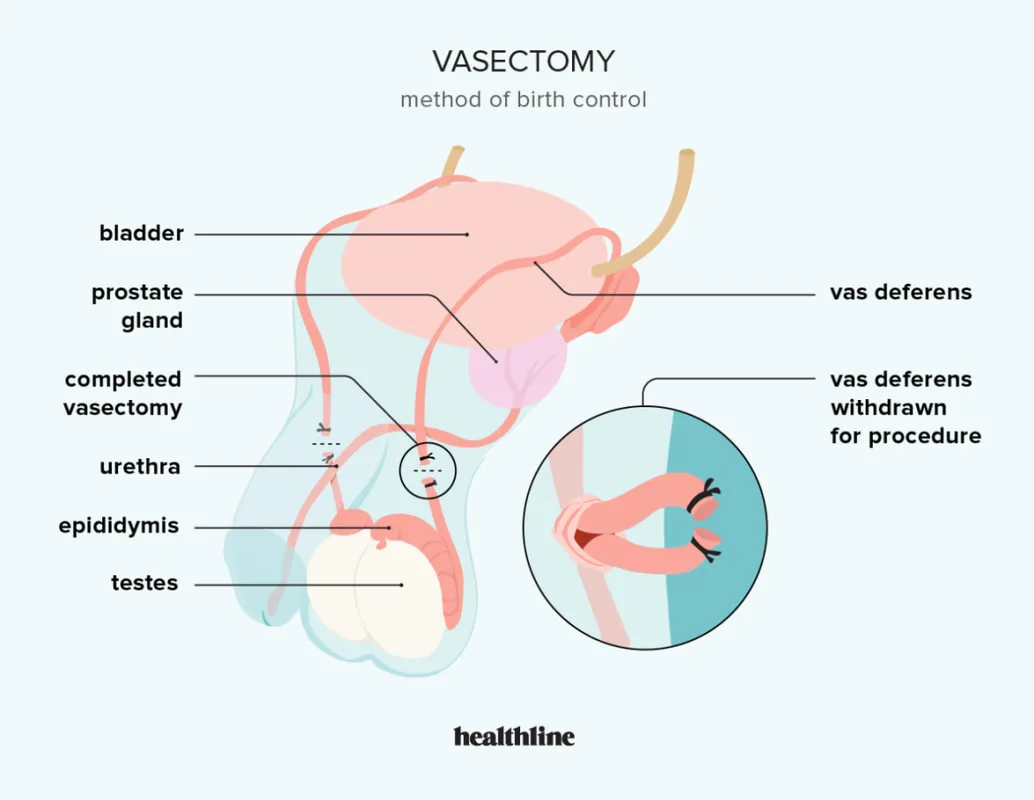
Spermatozoa generated in the testes are transported from the tail of the epididymis to the ejaculatory ducts via the vas deferens (ductus deferens). It passes via the inguinal canal and the scrotum and is 45 cm long. It enters the pelvis beneath the peritoneum that covers the lateral wall after passing across the external iliac artery. It joins the ipsilateral seminal vesicle at the ischial tuberosity, where it turns medially and crosses in front of the ureter to the base of the bladder. From there, it forms the ejaculatory duct, which passes through the prostate gland and opens into the prostatic urethra.
Vascular: The internal iliac artery supplies blood to the vas, which may be encased in venous varicosities, such as varicocele in the scrotum.
Investigations
Pre-op: Counseling and informed consent should be given by the patient and partner. The patient needs to be made aware that this surgery should be viewed as irreversible. Medical history is examined, and some medications are discontinued, such as aspirin one week before to surgery, if necessary.
Scrotal support is used for up to one week following surgery. A pair of distinct semen samples should verify azoospermia, and the patient should be cautioned to stick to pre-operative contraceptive treatments for a full 12-week period.
Actions
carried out while under local anesthesia. After shaving, skin needs to be washed with antiseptic. The two primary methods are no-scalpel and scalpel:
Scalpel: Holding the vas deferens between the thumb and two fingers, local anesthetic is injected, usually at the bilateral intersection of the middle and upper scrotal regions. On the scrotal surface, a tiny vertical incision is made above the vas. The surrounding tissue is cut away with a blunt knife, the vas deferens is extracted from the incision, and the middle portion is secured with a clip. A length (about 1-2 cm) is removed after the vas is tied.
Recanalization is stopped by cauterization to the severed ends, vas folding back, or fascial interposition. Haemostasis needs to be done carefully. Sutures that are simply interrupted are used to close the skin. The opposite side repeats this.
No-scalpel: A ring forceps is used to clamp the vas deferens when it has been felt beneath the skin. A dissecting forceps is used to puncture skin in order to create an opening. Using a ring clamp, the vas is extracted and treated similarly to a scalpel.
It is best to send the removed vas segment for histological confirmation.
Complications
Short-term: Sperm granuloma, epididymitis, haematoma, bruising, and infection.
Long-range: less than 1% of conceptions fail because of recanalization, surgical mistakes, anatomical variations, or ineffective contraception before azoospermia is confirmed.
Pelvic discomfort is not prevalent.
Indications
Contraception is optional (but it should be regarded as irreversible). Rarely, recurrent epididymitis (60 percent lower risk).
Anatomy
Spermatozoa generated in the testes are transported from the tail of the epididymis to the ejaculatory ducts via the vas deferens (ductus deferens). It passes via the inguinal canal and the scrotum and is 45 cm long. It enters the pelvis beneath the peritoneum that covers the lateral wall after passing across the external iliac artery. It joins the ipsilateral seminal vesicle at the ischial tuberosity, where it turns medially and crosses in front of the ureter to the base of the bladder. From there, it forms the ejaculatory duct, which passes through the prostate gland and opens into the prostatic urethra.
Vascular: The internal iliac artery supplies blood to the vas, which may be encased in venous varicosities, such as varicocele in the scrotum.
Investigations
Pre-op: Counseling and informed consent should be given by the patient and partner. The patient needs to be made aware that this surgery should be viewed as irreversible. Medical history is examined, and some medications are discontinued, such as aspirin one week before to surgery, if necessary.
Scrotal support is used for up to one week following surgery. A pair of distinct semen samples should verify azoospermia, and the patient should be cautioned to stick to pre-operative contraceptive treatments for a full 12-week period.
Actions
carried out while under local anesthesia. After shaving, skin needs to be washed with antiseptic. The two primary methods are no-scalpel and scalpel:
Scalpel: Holding the vas deferens between the thumb and two fingers, local anesthetic is injected, usually at the bilateral intersection of the middle and upper scrotal regions. On the scrotal surface, a tiny vertical incision is made above the vas. The surrounding tissue is cut away with a blunt knife, the vas deferens is extracted from the incision, and the middle portion is secured with a clip. A length (about 1-2 cm) is removed after the vas is tied.
Recanalization is stopped by cauterization to the severed ends, vas folding back, or fascial interposition. Haemostasis needs to be done carefully. Sutures that are simply interrupted are used to close the skin. The opposite side repeats this.
No-scalpel: A ring forceps is used to clamp the vas deferens when it has been felt beneath the skin. A dissecting forceps is used to puncture skin in order to create an opening. Using a ring clamp, the vas is extracted and treated similarly to a scalpel.
It is best to send the removed vas segment for histological confirmation.
Complications
Short-term: Sperm granuloma, epididymitis, haematoma, bruising, and infection.
Long-range: less than 1% of conceptions fail because of recanalization, surgical mistakes, anatomical variations, or ineffective contraception before azoospermia is confirmed.
Pelvic discomfort is not prevalent.
0 Comments
