- Published on
Clinical Procedures - Transferring a Patient Using a Log Roll
Use this technique to transfer patients in whom a cervical spine injury is suspected or confirmed. The following assumes that the patient's neck is immobilized in a brace or blocks.
Equipment
• Minimum 5 members of staff
• Patient transfer board or 'Patslide®
Procedure
• D The most senior member of the team should take charge of the patient's head and neck and initiate commands
• Ensure adequate explanation is given to the patient, and to all members of staff involved
• Place destination bed/trolley alongside origin bed/trolley
• Check bed is at waist height to prevent staff injuries
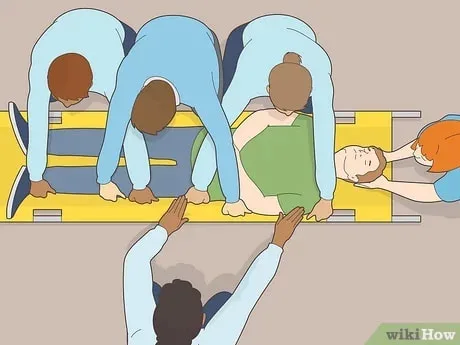
• 1 member of staff should position themselves at the head-end of the patient; the other 3 should be spread alongside the patient, at the origin side. The final member of staff should be at the destination side
• Check brakes on bed secure
• The person responsible for the patient's head should have one hand either side of the patient's head, supporting the patient's shoulders
• The person responsible for the patient's upper body should have one hand on the patient's distant shoulder, and the other on the lateral aspect of the patient's chest
• The person responsible for the patient's pelvis should have one hand on the lateral aspect of the patient's pelvi and the other under the patient's distant thigh
• The person responsible for the patient's lower legs should have both hands under the distant calf
• On the command 'Ready, Steady, Roll' the 3 members of staff at the side of the patient will slowly move backwards with straight arms, rolling the patient towards them
• The member of staff responsible for the patient's head will move sideways, ensuring alignment of the patients spine is preserved and that the neck is not rotated at all
• Staff at the bed/trolley onto which patient is to be transferred, put transfer board onto patient's bed/trolley
• On the command 'Ready, Steady, Roll' the 4 members of staff at the patient roll the patient back flat, keeping the neck straight
• 1 member of staff should now move around the bed such that there are 2 on each side and 1 at the head.
• On command of 'Ready, Steady, Move'
• Handlers should move the patient gently across on transfer board keeping the head and neck immobilized.
Procedures Tips
• Ensure sufficient time available to safely complete the manoeuvre
• Check bed area for any furniture/equipment that could be moved
• Staff should wear suitable (preferably low-heel) footwear and non-restrictive clothing
• D It is vital to have the correct amount of staff available
Do not rush, and leave enough time to explain the procedure to all present
• D It is essential that the patient's body be kept in alignment, and the manoeuvre is carried out in one smooth and controlled movement.
Risks
• Potential injuries to patient or staff arising from trailing leads, drains, etc.
• Disconnection of equipment during manoeuvre:
• Watch out for IV pumps, syringe drivers, catheters.
Documentation
• All patients should have assessments carried out within 24 hours of admission
• Care plan should be maintained/consulted as appropriate
• If there are any issues with equipment or manoeuvre, advise nurse in charge, document in notes, and complete an appropriate incident form.
Use this technique to transfer patients in whom a cervical spine injury is suspected or confirmed. The following assumes that the patient's neck is immobilized in a brace or blocks.
Equipment
• Minimum 5 members of staff
• Patient transfer board or 'Patslide®
Procedure
• D The most senior member of the team should take charge of the patient's head and neck and initiate commands
• Ensure adequate explanation is given to the patient, and to all members of staff involved
• Place destination bed/trolley alongside origin bed/trolley
• Check bed is at waist height to prevent staff injuries
• 1 member of staff should position themselves at the head-end of the patient; the other 3 should be spread alongside the patient, at the origin side. The final member of staff should be at the destination side
• Check brakes on bed secure
• The person responsible for the patient's head should have one hand either side of the patient's head, supporting the patient's shoulders
• The person responsible for the patient's upper body should have one hand on the patient's distant shoulder, and the other on the lateral aspect of the patient's chest
• The person responsible for the patient's pelvis should have one hand on the lateral aspect of the patient's pelvi and the other under the patient's distant thigh
• The person responsible for the patient's lower legs should have both hands under the distant calf
• On the command 'Ready, Steady, Roll' the 3 members of staff at the side of the patient will slowly move backwards with straight arms, rolling the patient towards them
• The member of staff responsible for the patient's head will move sideways, ensuring alignment of the patients spine is preserved and that the neck is not rotated at all
• Staff at the bed/trolley onto which patient is to be transferred, put transfer board onto patient's bed/trolley
• On the command 'Ready, Steady, Roll' the 4 members of staff at the patient roll the patient back flat, keeping the neck straight
• 1 member of staff should now move around the bed such that there are 2 on each side and 1 at the head.
• On command of 'Ready, Steady, Move'
• Handlers should move the patient gently across on transfer board keeping the head and neck immobilized.
Procedures Tips
• Ensure sufficient time available to safely complete the manoeuvre
• Check bed area for any furniture/equipment that could be moved
• Staff should wear suitable (preferably low-heel) footwear and non-restrictive clothing
• D It is vital to have the correct amount of staff available
Do not rush, and leave enough time to explain the procedure to all present
• D It is essential that the patient's body be kept in alignment, and the manoeuvre is carried out in one smooth and controlled movement.
Risks
• Potential injuries to patient or staff arising from trailing leads, drains, etc.
• Disconnection of equipment during manoeuvre:
• Watch out for IV pumps, syringe drivers, catheters.
Documentation
• All patients should have assessments carried out within 24 hours of admission
• Care plan should be maintained/consulted as appropriate
• If there are any issues with equipment or manoeuvre, advise nurse in charge, document in notes, and complete an appropriate incident form.
0 Comments
