- Published on
Dermatology - Hereditary Epidermolysis Bullosa ( Koebner Variant)
Hereditary epidermolysis bullosa is a spectrum of rare genodermatoses. Disturbed coherence
of the epidermis and/or dermis leads to blister formation following trauma.
Classification is based on the site of blister formation: epidermolytic or EB simplex (EBS),
junctional EB (JEB), and dermolytic, or dystrophic, EB (DEB). In each of these there are
several distinct types. Epidermolysis bullosus simplex (EBS) Koebner variant is a traumainduced,
intraepidermal blistering form that is dominantly inherited, with onset at birth to
early infancy.
Disease manifestations range from very mild to mutilating. There is generalized blistering
following trauma with a predilection for traumatized body sites such as feet, hands, elbows,
and knees.
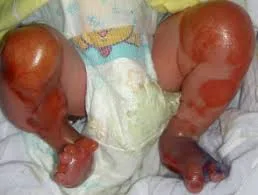
Lesions
Blisters are tense or flaccid at first and lead to erosions. There is rapid healing and only
minimal scarring at sites of repeated blistering. Palmoplantar hyperkeratoses may be
present. Nails, teeth, and oral mucosa are usually spared.
Diagnosis is based on clinical appearance and history. Histopathology determines the level
of cleavage, which is further defined by electron microscopy and/or immunohistochemical
mapping. Western blot, Northern blot, restriction fragment length polymorphism (RFLP)
analysis, and DNA sequences may then identify the mutated gene.
Management is tailored to the severity and extent of skin involvement and consists of supportive
skin care, supportive care for other organ systems, and systemic therapies for complications.
Wound management, nutritional support, and infection control are key and the
maintenance of a cool environment and use of soft, well-ventilated shoes are important.
Treat blistered skin with saline compresses and topical antibiotics or, in the case of inflammation,
with topical steroids.
Hereditary epidermolysis bullosa is a spectrum of rare genodermatoses. Disturbed coherence
of the epidermis and/or dermis leads to blister formation following trauma.
Classification is based on the site of blister formation: epidermolytic or EB simplex (EBS),
junctional EB (JEB), and dermolytic, or dystrophic, EB (DEB). In each of these there are
several distinct types. Epidermolysis bullosus simplex (EBS) Koebner variant is a traumainduced,
intraepidermal blistering form that is dominantly inherited, with onset at birth to
early infancy.
Disease manifestations range from very mild to mutilating. There is generalized blistering
following trauma with a predilection for traumatized body sites such as feet, hands, elbows,
and knees.
Lesions
Blisters are tense or flaccid at first and lead to erosions. There is rapid healing and only
minimal scarring at sites of repeated blistering. Palmoplantar hyperkeratoses may be
present. Nails, teeth, and oral mucosa are usually spared.
Diagnosis is based on clinical appearance and history. Histopathology determines the level
of cleavage, which is further defined by electron microscopy and/or immunohistochemical
mapping. Western blot, Northern blot, restriction fragment length polymorphism (RFLP)
analysis, and DNA sequences may then identify the mutated gene.
Management is tailored to the severity and extent of skin involvement and consists of supportive
skin care, supportive care for other organ systems, and systemic therapies for complications.
Wound management, nutritional support, and infection control are key and the
maintenance of a cool environment and use of soft, well-ventilated shoes are important.
Treat blistered skin with saline compresses and topical antibiotics or, in the case of inflammation,
with topical steroids.
0 Comments
