- Published on
Pathology - Membranoproliferative Glomerulonephritis
Linked to hereditary lack of complement components.
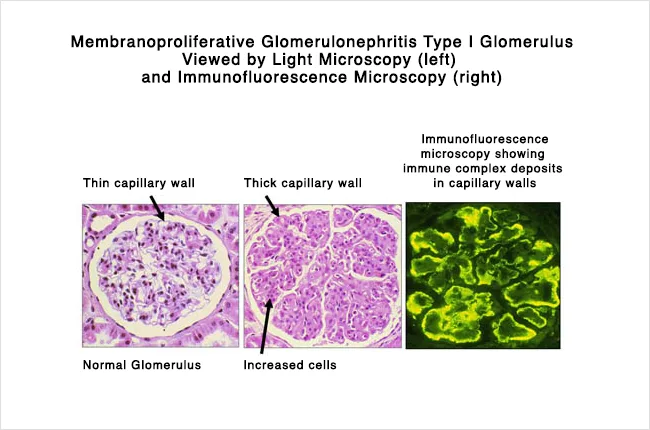
Type I is observed in systemic lupus erythematosus, hepatitis B and C, and entails activation of both the conventional and alternative pathways.
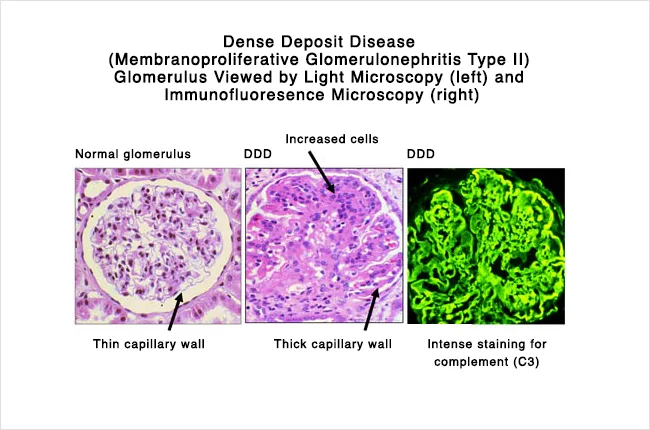
Type II specifically entails the activation of the alternative route exclusively.
The majority of affected patients are under 30 years old.
Types I and II: Under light microscopy, the basement membrane shows reduplication (splitting) and the mesangial matrix expands into the capillary loops, creating a tram track appearance.
Type I: Electron microscopy reveals electron-dense deposits located beneath the endothelium.
Type II: Electron microscopy reveals a distinct dense deposit of uniform material within the glomerular basement membrane.
Clinical Symptoms
Type I typically manifests with nephrotic syndrome.
Type II typically manifests as nephritic syndrome characterized by hematuria and persistent renal failure.
Laboratory results: Reduced C3 levels, increased BUN and Cr, presence of RBCs and/or RBC casts in urine.
Treatment include corticosteroids and immunosuppression if deemed suitable for the root cause.
Prognosis involves gradual progression to renal failure with a high likelihood of recurrence post-transplant.
Notes
Linked to hereditary lack of complement components.
Type I is observed in systemic lupus erythematosus, hepatitis B and C, and entails activation of both the conventional and alternative pathways.
Type II specifically entails the activation of the alternative route exclusively.
The majority of affected patients are under 30 years old.
Types I and II: Under light microscopy, the basement membrane shows reduplication (splitting) and the mesangial matrix expands into the capillary loops, creating a tram track appearance.
Type I: Electron microscopy reveals electron-dense deposits located beneath the endothelium.
Type II: Electron microscopy reveals a distinct dense deposit of uniform material within the glomerular basement membrane.
Clinical Symptoms
Type I typically manifests with nephrotic syndrome.
Type II typically manifests as nephritic syndrome characterized by hematuria and persistent renal failure.
Laboratory results: Reduced C3 levels, increased BUN and Cr, presence of RBCs and/or RBC casts in urine.
Treatment include corticosteroids and immunosuppression if deemed suitable for the root cause.
Prognosis involves gradual progression to renal failure with a high likelihood of recurrence post-transplant.
Notes
0 Comments
