- Published on
Pathology - Minimal Change Disease (Lipoid Nephrosis)
The cause is unidentified, however it is often linked to a viral upper respiratory infection. It is theorized that circulating T cells may release a cytokine that harms the glomerulus. It has also been connected to Hodgkin's disease and hypersensitivity reactions.
Primarily observed in young boys, but can also manifest in girls, older children, and adults.
Pathology
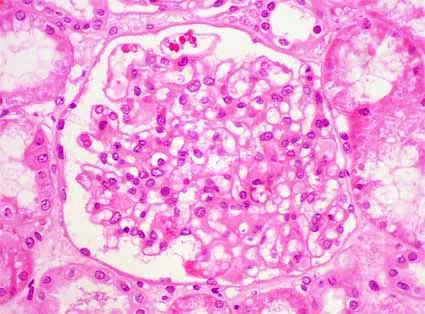
Light microscopy reveals normal-appearing glomeruli with visible lipid buildup in renal tubular cells.
Electron microscopy shows the fusion of epithelial foot processes.
Clinical Symptoms
Nephrotic syndrome presenting with edema, hypertension, and malaise.
Possible complications involve infection by gram-positive bacteria, thrombosis, shock, and protein deficiency.
Prednisone for steroid-resistant patients; cyclophosphamide or cyclosporine.
ACE inhibitors are used to decrease proteinuria.
The prognosis is very good, particularly in those who respond well to steroids.
Minimal change disease is the classic example of nephrotic syndrome.
The cause is unidentified, however it is often linked to a viral upper respiratory infection. It is theorized that circulating T cells may release a cytokine that harms the glomerulus. It has also been connected to Hodgkin's disease and hypersensitivity reactions.
Primarily observed in young boys, but can also manifest in girls, older children, and adults.
Pathology
Light microscopy reveals normal-appearing glomeruli with visible lipid buildup in renal tubular cells.
Electron microscopy shows the fusion of epithelial foot processes.
Clinical Symptoms
Nephrotic syndrome presenting with edema, hypertension, and malaise.
Possible complications involve infection by gram-positive bacteria, thrombosis, shock, and protein deficiency.
Prednisone for steroid-resistant patients; cyclophosphamide or cyclosporine.
ACE inhibitors are used to decrease proteinuria.
The prognosis is very good, particularly in those who respond well to steroids.
Minimal change disease is the classic example of nephrotic syndrome.
0 Comments
