- Published on
Pathology - Secondary Hyperparathyroidism
Primarily due to chronic renal insufficiency.
Parathyroid gland shows diffuse expansion due to hyperplasia of principal cells.
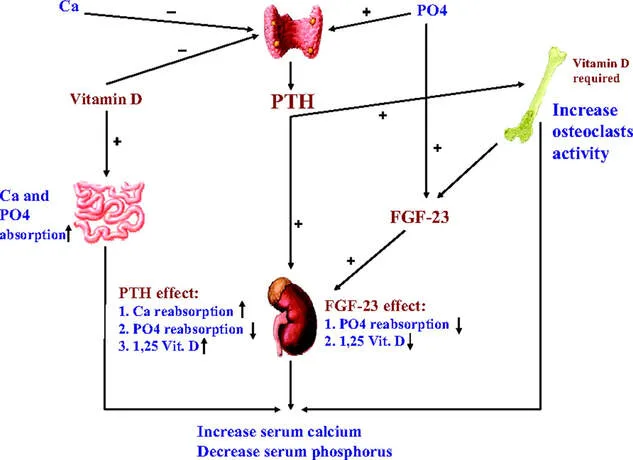
Pathophysiology: Reduced l,25-(OH)2 D3 generation from deteriorating kidney function leads to diminished intestinal calcium absorption resulting in hypocalcemia. This condition is additionally exacerbated by elevated calcium excretion from the impaired kidney, leading to higher parathyroid hormone (PTH) levels.
Clinical Symptoms and Signs
Osteoclastic bone disease with widespread distribution; metastatic calcification in soft tissues.
Laboratory results: Low calcium levels, elevated parathyroid hormone (PTH), elevated serum alkaline phosphatase, elevated serum phosphate.
Therapy
If the disease is severe, the aberrant glands will be surgically removed.
Phosphate binders and vitamin D supplementation.
Primarily due to chronic renal insufficiency.
Parathyroid gland shows diffuse expansion due to hyperplasia of principal cells.
Pathophysiology: Reduced l,25-(OH)2 D3 generation from deteriorating kidney function leads to diminished intestinal calcium absorption resulting in hypocalcemia. This condition is additionally exacerbated by elevated calcium excretion from the impaired kidney, leading to higher parathyroid hormone (PTH) levels.
Clinical Symptoms and Signs
Osteoclastic bone disease with widespread distribution; metastatic calcification in soft tissues.
Laboratory results: Low calcium levels, elevated parathyroid hormone (PTH), elevated serum alkaline phosphatase, elevated serum phosphate.
Therapy
If the disease is severe, the aberrant glands will be surgically removed.
Phosphate binders and vitamin D supplementation.
0 Comments
