- Published on
Pathology -Severe Combined Immunodeficiency Disease (SCID)
Adenosine deaminase deficiency, tyrosine kinase deficiency, failure to synthesize class II MHC antigens, or a defective recombinase-activating gene mutation account for the remaining cases of autosomal recessive disorders, which cause other mutations. Fifty-five percent of cases are caused by X-Iinked recessive disorders, which result in defective IL-2 receptors on T cells.
Presents by three months of age on average.
Lymphoid tissues: Hypoplastic with depleted T-cell regions; small, undifferentiated thymus with low lymphocyte counts; other lymphoid tissues.
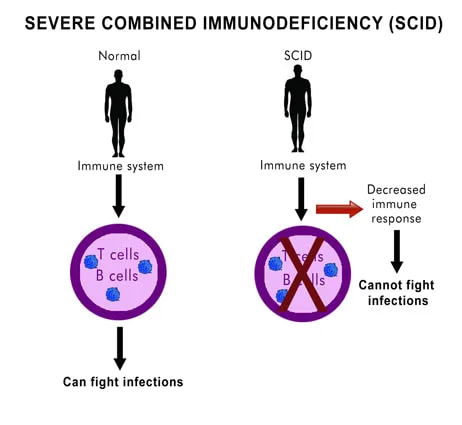
Pathophysiology: Mutations lead to abnormal lymphocyte growth and function, which impairs T cell and, occasionally, B cell differentiation. Consequently, there is a reduction in the generation of antibodies.
Clinical Signs and Symptoms
severe, recurring infections caused by bacteria, fungi, viruses, and protozoa (particularly susceptible to C. albicans, Pneumocystis carinii, Pseudomonas, CMV, and VZV); may also manifest as severe diarrhea, thrush, and failure to thrive.
Results from the lab: severe lymphopenia; reduced levels of total immunoglobulin.
Treatments include bone marrow transplantation, infection control, routine IVIG delivery, and experimental adenosine deaminase gene transplantation have all been examined.
Adenosine deaminase deficiency, tyrosine kinase deficiency, failure to synthesize class II MHC antigens, or a defective recombinase-activating gene mutation account for the remaining cases of autosomal recessive disorders, which cause other mutations. Fifty-five percent of cases are caused by X-Iinked recessive disorders, which result in defective IL-2 receptors on T cells.
Presents by three months of age on average.
Lymphoid tissues: Hypoplastic with depleted T-cell regions; small, undifferentiated thymus with low lymphocyte counts; other lymphoid tissues.
Pathophysiology: Mutations lead to abnormal lymphocyte growth and function, which impairs T cell and, occasionally, B cell differentiation. Consequently, there is a reduction in the generation of antibodies.
Clinical Signs and Symptoms
severe, recurring infections caused by bacteria, fungi, viruses, and protozoa (particularly susceptible to C. albicans, Pneumocystis carinii, Pseudomonas, CMV, and VZV); may also manifest as severe diarrhea, thrush, and failure to thrive.
Results from the lab: severe lymphopenia; reduced levels of total immunoglobulin.
Treatments include bone marrow transplantation, infection control, routine IVIG delivery, and experimental adenosine deaminase gene transplantation have all been examined.
0 Comments
