- Published on
Surgery - Colonic Polyps
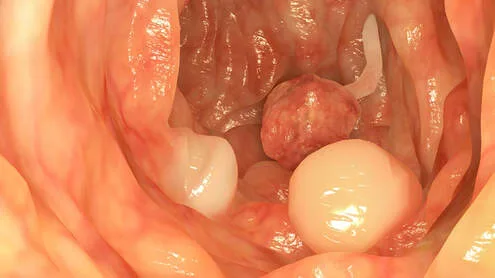
A development or protrusion that extends into the colonic lumen from the gut wall.
Etiology
divided into two categories: neoplastic polyps (mostly benign adenomas, inflammatory pseudopolyps, hyperplastic polyps, hamartomatous polyps) and non-neoplastic polyps (mostly benign mucosal and submucosal proliferations) that are clinically relevant because they may develop into malignancies.
Among the several polyp syndromes are the following:
Characteristics of the Disorder
Peutz-Jeghers syndrome: diffuse gastrointestinal polyposis accompanied by mucocutaneous lip and gum discolorationbenign.
Multiple stomach, small, and large bowel adenomas are symptoms of familial polyposis coli.
APC gene with autosomal dominance. precancerous.
Gardner's syndrome is characterized by multiple colonic adenomas, osseomas, soft tissue tumors, sebaceous cysts, and congenital enlargement of the RPE. precancerous.
Turcot's syndrome: numerous colonic adenomas along with glioblastomas or medulloblastomas. precancerous.
Alopecia, nail atrophy, pigmentation, watery diarrhea, and numerous colonic adenomas are the symptoms of Cronkhite-Canada's syndrome. precancerous.
Epidemiology
Typical. Over 50% of people over 60 have the prevalence.
History
often asymptomatic, but can sporadically result in bleeding, mucoid diarrhea, anemia, or serve as a gateway for intussusception.
Examination
Usually no results from the analysis.
If low in the rectum, may be perceptible on PR examination.
Investigations
FBC blood (anemia).
Blood in the stool: frank or occult blood.
Endoscopy: The gold standard of investigation is a colonoscopy. An upper GI endoscopy is required to search for upper GI polyps in patients with multiple polyposis syndromes. To determine the type of excised polyp, a histological examination is required.
Management
Endoscopic procedures include endoscopic mucosal resection and polypectomy. For big rectal polyps, transanal endoscopic microsurgery is used.
Surgical: It can be necessary to remove large polyps by surgery. Early subtotal colectomy is advised in numerous polyposis syndromes (especially familial polyposis coli) in order to lower the risk of cancer.
Follow-up: Depending on the kind, size, and quantity of polyps, patients should undergo colonoscopies on a regular basis. In cases of numerous polyposis syndromes, families may need to undergo genetic screening.
Complications
The two malignant changes that carry the highest risk are multiple polyposis syndromes and villous adenomas.
Prognosis
If identified and treated prior to any malignant transformation, I'm good. Adenomas take around seven years to grow into cancer.
A development or protrusion that extends into the colonic lumen from the gut wall.
Etiology
divided into two categories: neoplastic polyps (mostly benign adenomas, inflammatory pseudopolyps, hyperplastic polyps, hamartomatous polyps) and non-neoplastic polyps (mostly benign mucosal and submucosal proliferations) that are clinically relevant because they may develop into malignancies.
Among the several polyp syndromes are the following:
Characteristics of the Disorder
Peutz-Jeghers syndrome: diffuse gastrointestinal polyposis accompanied by mucocutaneous lip and gum discolorationbenign.
Multiple stomach, small, and large bowel adenomas are symptoms of familial polyposis coli.
APC gene with autosomal dominance. precancerous.
Gardner's syndrome is characterized by multiple colonic adenomas, osseomas, soft tissue tumors, sebaceous cysts, and congenital enlargement of the RPE. precancerous.
Turcot's syndrome: numerous colonic adenomas along with glioblastomas or medulloblastomas. precancerous.
Alopecia, nail atrophy, pigmentation, watery diarrhea, and numerous colonic adenomas are the symptoms of Cronkhite-Canada's syndrome. precancerous.
Epidemiology
Typical. Over 50% of people over 60 have the prevalence.
History
often asymptomatic, but can sporadically result in bleeding, mucoid diarrhea, anemia, or serve as a gateway for intussusception.
Examination
Usually no results from the analysis.
If low in the rectum, may be perceptible on PR examination.
Investigations
FBC blood (anemia).
Blood in the stool: frank or occult blood.
Endoscopy: The gold standard of investigation is a colonoscopy. An upper GI endoscopy is required to search for upper GI polyps in patients with multiple polyposis syndromes. To determine the type of excised polyp, a histological examination is required.
Management
Endoscopic procedures include endoscopic mucosal resection and polypectomy. For big rectal polyps, transanal endoscopic microsurgery is used.
Surgical: It can be necessary to remove large polyps by surgery. Early subtotal colectomy is advised in numerous polyposis syndromes (especially familial polyposis coli) in order to lower the risk of cancer.
Follow-up: Depending on the kind, size, and quantity of polyps, patients should undergo colonoscopies on a regular basis. In cases of numerous polyposis syndromes, families may need to undergo genetic screening.
Complications
The two malignant changes that carry the highest risk are multiple polyposis syndromes and villous adenomas.
Prognosis
If identified and treated prior to any malignant transformation, I'm good. Adenomas take around seven years to grow into cancer.
0 Comments
